Healthcare Program Governance: A Practical Guide to Clear Decisions and Execution
By CJ Marshall, President & Founder
Learn how healthcare program governance clarifies decision rights, fixes escalation paths, and drives accountability to keep clinical initiatives on track.

Article by
Chelvis “CJ” Marshall
Chelvis “CJ” Marshall is President and Founder of Marshall Solutions Group, a management consulting firm specializing in Strategy & Operations, Organizational Leadership & Change, and Program & Project Management.
A retired U.S. Navy Senior Chief who advanced from E-1 to E-8 in 10 years, CJ transitioned into Fortune 500 enterprise sales and leadership, generating more than $20 million in commercial sales. He brings extensive operational experience leading teams, managing complex programs, and overseeing mission-critical operations.
His work focuses on bridging leadership and execution, helping organizations translate strategic priorities into disciplined execution, organizational accountability, and measurable business outcomes.
A healthcare program can be active on every front and still be stuck. When clinical, operational, and executive stakeholders share responsibility but lack clear decision rights, routine issues drift upward, escalations arrive without an owner or workable options, and status reports describe activity instead of progress. That’s not an effort problem. It’s a healthcare program governance problem.
Effective healthcare program governance connects decisions to delivery. It clarifies who decides, who advises, and who executes, while giving leaders a regular view of risks, dependencies, and measurable outcomes. This guide explains how to define those roles, set escalation paths that surface issues early, and establish oversight that supports accountability without slowing necessary work. The goal is practical: align program priorities with organizational outcomes and make the next decision clear.
Key Takeaways
- Healthcare program governance defines who has authority, provides oversight, handles escalation, and remains accountable for delivery. Keep it distinct from broader health-system, organizational, and health information governance.
- Start with the program’s outcomes and scope, then map stakeholders and assign who decides, advises, executes, and receives updates.
- Set escalation paths and review meetings around decisions and risks that could affect delivery, not just routine status reporting.
- Test whether decisions happen on time, owners close actions, and risks reach the right leaders. More oversight won’t resolve capacity limits or competing priorities on its own.
Table of Contents
What healthcare program governance does, and what it does not
Healthcare program governance sets the authority, oversight, escalation, and accountability needed to deliver a defined initiative. It answers practical questions: Who can approve a scope change? Which leader resolves a resource conflict? Who owns a risk until it is addressed? Without clear answers, decisions stall, teams receive competing priorities, and risks sit in meeting notes without an accountable owner.
This is narrower than health-system governance, which concerns oversight of a health system, and organizational governance, which sets authority across an organization. Health information governance focuses on how information is managed. Health policy covers broader choices about financing, access, and quality, as outlined in Health Policy and Governance. Program governance applies to a particular initiative and the decisions required to move it forward.
For a related discussion of how leadership alignment affects operations, see the healthcare operations management guide.
The video below discusses governance and clinical safety in the context of healthcare AI. It illustrates why a program needs clear decision authority, but it doesn’t replace governance design for other types of initiatives.
How program governance differs from program management
Governance sets direction, authority, and oversight. Program management coordinates the work within that direction by tracking dependencies, organizing delivery, and bringing decisions or risks forward. The two must connect, but they aren’t interchangeable. A program manager can surface a resource conflict; the designated leader decides how to resolve it.
Governance also doesn’t transfer clinical judgment or formal organizational authority to a program committee. Those remain with the leaders designated to hold them. Effective healthcare program governance makes that boundary explicit, so delivery teams can act within their remit and escalate decisions that exceed it.
How to establish healthcare program governance that supports delivery
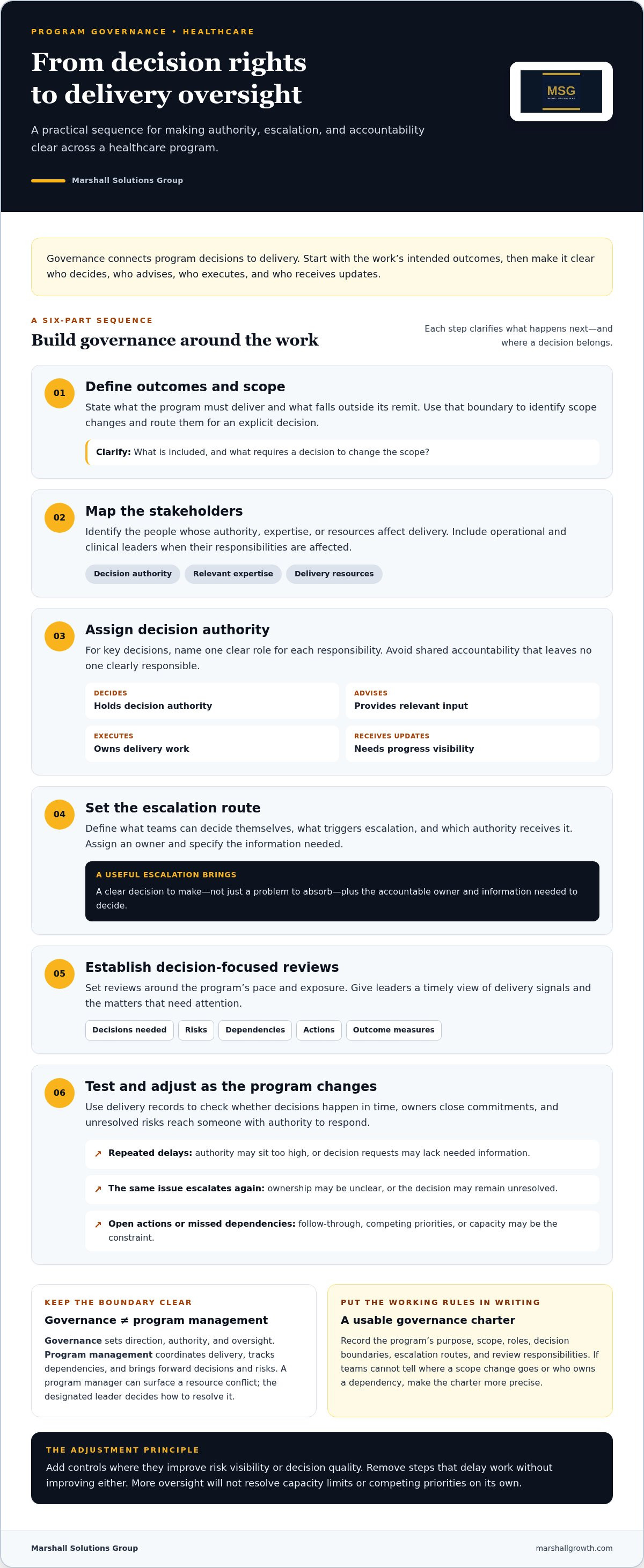
Build healthcare program governance around the work’s real decisions, not a template. First define the intended outcomes and what falls within scope. Then map the stakeholders whose authority, expertise, or resources affect delivery. Assign decision rights, establish escalation routes, and set reviews that give leaders a timely view of progress and risk.
- Define outcomes and scope. State what the program must deliver and what is outside its remit. This gives teams a basis for identifying scope changes and routing them for an explicit decision.
- Map stakeholders. Identify decision-makers, advisers, delivery owners, and people who need updates. Include operational and clinical leaders when their responsibilities are affected.
- Assign authority. For key decisions, name who decides, who advises, who executes, and who receives updates. Avoid shared accountability that leaves no one clearly responsible.
- Set escalation. Specify which decisions teams can make themselves, what triggers escalation, and who receives it. Make clear what information should accompany an escalation.
- Establish reviews. Review decisions needed, risks, dependencies, actions, and outcome measures. Adjust the meeting rhythm to the program’s pace and exposure.
Set decision rights, escalation, and review routines
Record the working rules in a governance charter: purpose, scope, roles, decision boundaries, escalation routes, and review responsibilities. Keep it usable. If a team cannot tell where a scope change goes or who owns a cross-functional dependency, the charter needs more precision.
An escalation path is the agreed route for a decision that falls outside a team’s delegated authority. Define the trigger, receiving authority, required information, and accountable owner. An escalation should present a clear decision to make, not just a problem to absorb.
Set reviews around decisions and delivery signals, not calendar habit. If a program includes data-use decisions, AHIMA’s Healthcare Data Governance Best Practices can inform that specialized area, while program governance still needs to assign delivery authority. Governance works best when connected to wider operational discipline. For support aligning program decisions with execution, explore program and project management support.
How to test and adjust governance as a healthcare program changes
Governance should change when the program’s scope, risk, or dependencies change. Test whether decisions are made within the time the work requires, action owners close commitments, and unresolved risks reach someone with authority to respond. A meeting can happen on schedule while these conditions fail. Attendance and completed reports aren’t proof that oversight is working.
Look for patterns in delivery records:
- Repeated delays may mean authority sits too high or decision requests lack the information leaders need.
- The same issue escalating more than once can signal unclear ownership or a decision that was never resolved.
- Open actions and missed dependencies may point to weak follow-through, competing priorities, or insufficient capacity.
These signals help distinguish weak governance from weak execution. If a team knows who decides but lacks the time or people to deliver, adding approval steps won’t solve the constraint. Address capacity and priority conflicts directly. Conversely, when a decision carries greater risk or depends on several functions, additional review or a tighter escalation threshold may be warranted. The tradeoff is practical: add controls where they improve risk visibility or decision quality, and remove steps that create delay without improving either.
Use evidence from delivery to recalibrate oversight
Review decision delays, repeated escalations, unresolved actions, and missed dependencies alongside changes in scope and risk. Then adjust the mechanism causing friction: delegate decisions that no longer need executive review, shorten the time before unresolved risks are escalated, or change reporting so leaders see dependencies that threaten outcomes. Don’t change the whole structure when one boundary is the problem.
Revisit the governance arrangements when the program adds work, shifts priorities, or encounters a new dependency. The aim isn’t more oversight. It’s the right oversight for the work now underway. Leaders aligning governance with delivery can explore MSG’s program management support.
Put governance to work in the next decision
Choose a consequential decision already facing the program and trace what happens next: who owns it, who has authority, and how the decision reaches the people responsible for delivery. That small test can reveal whether governance works in practice, not just on paper. Keep learning from the work as priorities and dependencies shift.
Marshall Solutions Group’s Program & Project Management supports governance for complex, high-volume initiatives. MSG’s embedded delivery approach stays through implementation, with aligned incentives, keeping governance connected to execution rather than treating it as a plan that ends at approval.
If your leaders are ready to connect oversight with the work underway, explore MSG’s program management support.
Frequently Asked Questions
Does every healthcare program need a steering committee?
No. A steering committee is useful when a program needs recurring decisions across functions or leaders must resolve competing priorities. A smaller initiative may work with a designated sponsor and an existing leadership forum. In healthcare program governance, choose the lightest structure that can make the decisions the work requires. Creating a committee without decision authority adds coordination, not control.
Can healthcare program governance slow decisions down?
Yes, especially when the same decision goes through several forums or teams revisit settled issues because the rationale isn’t recorded. Keep a decision log with the choice, rationale, accountable owner, and conditions that would justify reopening it. That helps distinguish a genuinely new issue from an old decision being recycled, without adding another approval layer.
How should governance work when a healthcare program spans multiple organizations?
Agree on shared decisions before delivery depends on them. Each organization should name a counterpart, clarify which commitments it can make, and identify matters requiring approval through its own leadership. Use a joint forum for cross-organization dependencies and shared outcomes, while keeping internal approvals within each organization. This prevents a joint group from appearing to hold authority it doesn’t have.
What should leaders do when program governance is already in place but delivery is still off track?
First, confirm that the program is still solving the problem leaders intended to address. Assumptions, expected benefits, or acceptance criteria may have shifted even if the formal scope hasn’t. Ask the sponsor and delivery owners to describe the intended outcome in the same terms, then compare completed deliverables with evidence that they meet agreed criteria. Resolve any mismatch before revising the plan.
Disclaimer
The information provided in this article is for general informational and educational purposes only and does not constitute legal, financial, accounting, engineering, or other professional advice. Marshall Solutions Group, Inc. makes no representations or warranties regarding the completeness or applicability of this information to any specific situation. Readers should consult appropriately qualified professionals before making decisions requiring specialized professional advice.