Healthcare Program Accountability: How Financial and Performance Measures Work
By CJ Marshall, President & Founder
Learn how healthcare program accountability connects financial reporting to performance measures, operational oversight, and measurable delivery outcomes.

Article by
Chelvis “CJ” Marshall
Chelvis “CJ” Marshall is President and Founder of Marshall Solutions Group, a management consulting firm specializing in Strategy & Operations, Organizational Leadership & Change, and Program & Project Management.
A retired U.S. Navy Senior Chief who advanced from E-1 to E-8 in 10 years, CJ transitioned into Fortune 500 enterprise sales and leadership, generating more than $20 million in commercial sales. He brings extensive operational experience leading teams, managing complex programs, and overseeing mission-critical operations.
His work focuses on bridging leadership and execution, helping organizations translate strategic priorities into disciplined execution, organizational accountability, and measurable business outcomes.
Healthcare program accountability isn’t captured by one score. It is measured through financial reporting on how funds are used, performance measures that show whether services meet their goals, and oversight of taxpayer-funded programs. It connects spending to results: leaders need to understand where resources go and what they help deliver.
That distinction matters. A program can stay within budget yet fall short on access or quality, while strong performance measures mean little if financial controls are weak. This article explains how financial and performance measures work together, what oversight looks like in programs such as Medicaid managed care, and how clear ownership and reliable data make accountability practical rather than punitive.
Key Takeaways
- Pair financial reporting with measures of access, quality, and timeliness; staying within budget alone doesn’t show whether a program is meeting its goals.
- Choose indicators and benchmarks that fit the program’s objectives, then assign clear ownership for reviewing results and addressing gaps.
- Medicaid managed care accountability includes shared federal and state responsibility for appropriate payment, access to quality care, and preventing fraud, waste, and abuse.
- When measures exist but ownership or follow-through is unclear, an operational assessment can help connect performance expectations to day-to-day execution.
Table of Contents
1. Defining Accountability - How is Accountability Measured in Healthcare?
Healthcare program accountability connects program actions to patient access, affordability, and health outcomes. Measures can include infection rates, patient satisfaction, and timeliness of care. Together, they show whether services are reaching patients and where care processes may need attention.
Watch this overview of healthcare performance indicators:
Patients Rising calls for federal and state programs to report measurable progress in access, affordability, and outcomes. NCQA describes quality measurement as a key accountability tool in most Medicaid programs. For measures to be useful, they need clear definitions, consistent review, and follow-up action.
Clinicians and patients can agree on measurable treatment goals, document relevant information accurately and promptly, and review progress together. If a patient struggles to meet a goal, discuss obstacles and adjust the plan. Anonymous satisfaction surveys can surface concerns about communication or timeliness. Fair coverage also requires examining barriers patients and providers face in accessing appropriate care.
To improve accountability, assign an owner to each measure, establish a review process, and give employees a clear way to raise concerns. Common risks include incomplete records, delayed reporting, measures that overlook patient needs, and blame-focused responses that discourage staff from reporting problems.
Patients can find performance and quality information in public program reports and materials from health plans or providers. Compare measure definitions and reporting periods before interpreting results. Satisfaction scores describe patient experience, not every aspect of clinical quality.
2. Financial and performance accountability
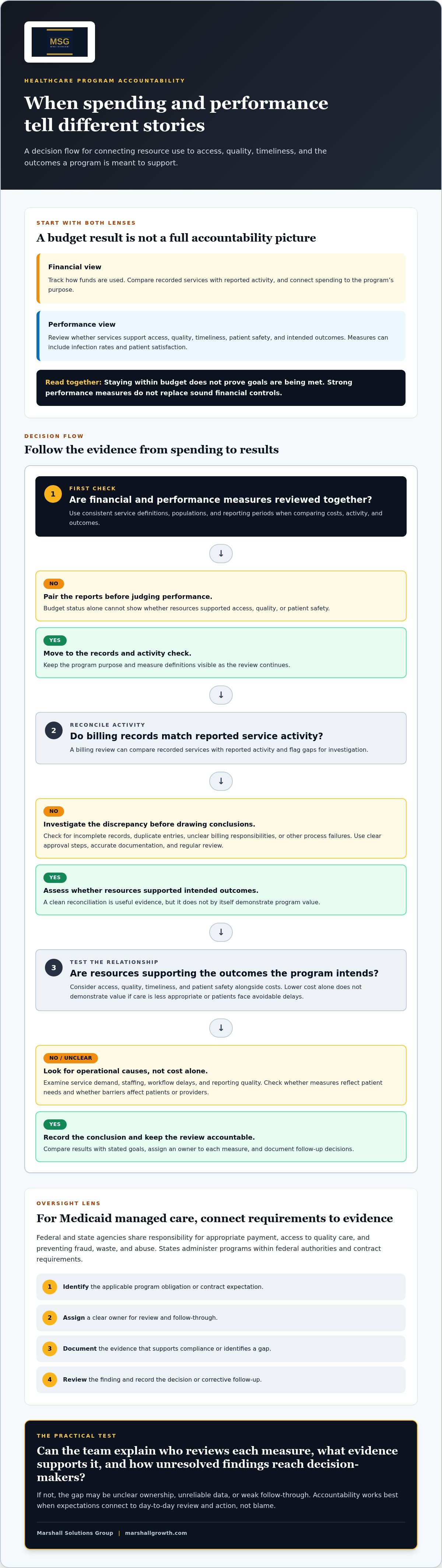
Financial accountability starts with tracking and reporting how healthcare facilities use monetary resources. Pair spending records with the program’s purpose, service activity, and defined performance measures. For example, a billing review can compare recorded services with reported activity and flag gaps for investigation.
To compare outcomes, costs, and value, use consistent service definitions, populations, and reporting periods. Then assess whether the resources used supported the intended outcomes, including access, quality, and patient safety. Lower cost alone doesn’t demonstrate value if patients receive less appropriate care or face avoidable delays.
Nonprofit hospitals receive tax benefits in exchange for serving their communities. Accountability therefore includes examining whether services and resources align with community needs. Leaders can discuss how funds support care, what performance measures show, and where results point to operational changes.
Fraud and abuse cost healthcare organizations billions of dollars each year. Clear approval steps, accurate records, and regular review help organizations spot questionable activity and strengthen oversight. Controls should distinguish intentional misuse from process failures, such as duplicate entries or unclear billing responsibilities.
Make the review actionable: assign an owner to each measure, compare results with the program’s stated goals, and document follow-up decisions. If spending rises while outcomes stall, examine service demand, staffing, workflow delays, and reporting quality before assuming cost alone explains the problem. Review medical and operational measures together: financial reports show resource use, while performance data show what those resources helped deliver. Start by mapping how billing and outcome information move through the organization, then identify where ownership or follow-through breaks down.
3. Oversight of taxpayer-funded healthcare programs
For Medicaid managed care, accountability operates through federal authorities, state administration, and program contracts. According to MACPAC, Section F of its June 2011 report examines state and federal oversight, including program integrity requirements and comprehensive risk-based contract requirements.
What laws and regulations govern accountability in U.S. healthcare programs? The applicable authorities and contract terms depend on the program. For Medicaid managed care, MACPAC describes federal and state oversight requirements, including proper payment for appropriate, high-quality care in fee-for-service and managed care.
Federal and state agencies share responsibility for appropriate payment, access to quality care, and preventing fraud, waste, and abuse. In practice, oversight must connect these expectations to data, review processes, and corrective actions. Data can inform policy development, but limits on collection can make comparisons difficult.
How do CMS programs hold hospitals and providers accountable? Program oversight uses defined requirements and performance information to assess payment integrity, access, and care quality. For Medicaid managed care, states administer programs within federal authorities and contract requirements, while federal oversight shares responsibility for program integrity.
Turn requirements into a working control process: identify each obligation, assign an owner, document evidence, and review gaps. For example, a program team can trace a payment concern from the contract expectation through supporting records and the decision to follow-up action. This makes ownership visible and helps distinguish a data problem from a process failure.
Oversight also depends on clear expectations for health plans and their provider networks. The American Hospital Association has called for regulators to monitor health plans for abusive payment delays and denials. These concerns show why measures should examine both payment practices and their effect on providers’ ability to deliver care to members.
For leaders, the operational test is straightforward: can teams explain who reviews each requirement, what evidence supports compliance, and how unresolved findings reach decision-makers? If those steps are unclear, oversight may identify problems without prompting timely corrective action.
Marshall Solutions Group: Operational Assessment
Marshall Solutions Group’s operational assessment helps leaders identify where accountability breaks down between program expectations and daily execution. It examines how responsibilities, decision-making, reporting, and performance measures fit together, then clarifies operational gaps that obstruct follow-through.
Consider an assessment when teams collect performance data but lack clear ownership for responding to it, or when oversight findings repeatedly stall between departments. The goal is to give leaders a practical view of the processes and responsibilities that need attention, not to replace clinical judgment or legal and regulatory advice.
When the challenge is translating findings into coordinated action, Strategy & Operations Consulting or Program & Project Management can support planning and execution. Contact Marshall Solutions Group to discuss the accountability challenge your organization needs to address.
Make Accountability Part of the Operating System
Healthcare program accountability is strongest when leaders treat it as an ongoing management discipline, not a report prepared for review. Start by identifying where information, decisions, and ownership fail to connect, then make the necessary changes part of routine operations.
Marshall Solutions Group’s operational assessment helps leaders examine those gaps. Strategy & Operations Consulting can support clearer execution, while Organizational Leadership & Change can help align responsibilities and expectations across teams. The right starting point depends on whether the main barrier is unclear direction, inconsistent follow-through, or resistance to changed practices.
Set a focused improvement priority, name who will lead it, and establish how leadership will review progress. Consistent follow-through turns accountability from a compliance exercise into a way to strengthen program delivery.
Contact Marshall Solutions Group to discuss your organization’s accountability priorities. Clear ownership and disciplined execution can help teams move forward with confidence.
Frequently Asked Questions
Defining Accountability - How is Accountability Measured in Healthcare?
For clinicians, accountability includes putting a patient’s best interests first and being able to justify professional actions. In behavioral health, treatment plans, rating scales, and checklists can help document whether an approach is helping. The key is to connect clinical decisions to the patient’s agreed goals and explain why the care plan remains appropriate or needs revision.
What does healthcare program accountability mean?
Healthcare program accountability means being answerable for decisions and responsibilities tied to a program’s purpose. It can involve different relationships: a clinician explaining a care decision, an organization responding to an insurer, or public officials addressing residents’ health concerns in a meeting. The common thread is clear explanation, not merely completing an assigned task.
What are the main accountability frameworks for healthcare programs?
There isn’t one framework for every program. NCQA’s health equity measurement framework for state Medicaid programs uses six core quality domains, each associated with two to five measures. NCQA also reviewed four approaches for possible use by state Medicaid programs. These examples show how a framework can organize measures, while program leaders still need to select indicators suited to their objectives.
How is healthcare program performance measured and reported?
For equitable-care reporting, NCQA identifies social determinants of health indicators, a reference group, quality metrics, and benchmarks as factors in selecting a measurement approach. The reference group provides a comparison point; indicators and measures define what is assessed. Reporting these choices alongside results helps readers understand what a comparison can show and where its limits lie.
Who is responsible for oversight of healthcare programs?
Responsibility depends on the program, but Medicaid managed care oversight is shared by federal and state governments. Their responsibilities include appropriate payment, access to quality care, and preventing fraud, waste, and abuse. Program data supports policy development, yet collection challenges and limitations can affect oversight decisions. Leaders should therefore consider how data quality shapes what reviewers can conclude.
Disclaimer
The information provided in this article is for general informational and educational purposes only and does not constitute legal, financial, accounting, engineering, or other professional advice. Marshall Solutions Group, Inc. makes no representations or warranties regarding the completeness or applicability of this information to any specific situation. Readers should consult appropriately qualified professionals before making decisions requiring specialized professional advice.