How to Convince Investors You Need Operational Help
By CJ Marshall, President & Founder
Learn how to convince investors you need operational help by framing bottlenecks as execution risks, defining clear ownership, and proving business impact.

Article by
Chelvis “CJ” Marshall
Chelvis “CJ” Marshall is President & Founder of Marshall Solutions Group, a management consulting firm specializing in Strategy & Operations, Organizational Leadership & Change, and Program & Project Management. A retired U.S. Navy Senior Chief who advanced from E-1 to E-8 in 10 years, CJ transitioned into Fortune 500 enterprise leadership, where he personally generated $20 million in career sales. He has led organizations of up to 400 personnel, overseen complex engineering operations, and managed mission-critical programs. His work focuses on bridging leadership and execution—helping organizations translate strategic direction into disciplined execution, stronger accountability, and measurable business results.
Requesting operational help isn’t a confession of weak leadership. It’s a decision about execution risk. If you’re figuring out how to convince investors you need operational help, lead with the constraint, not the job title: identify the decisions, handoffs, or delivery work slowing commitments, then show what those delays put at risk. Investors are right to ask whether added support will improve control or simply add overhead.
Build an evidence-led case by connecting the bottleneck to business consequences, defining the capacity needed, and clarifying what remains your responsibility as founder. Propose measures and review points so investors can assess progress and adjust course if needed. The case is strongest when support addresses a defined operating problem, has clear ownership, and is measured against results, not a vague promise to “scale better.”
Key Takeaways
- Separate visible delays and rework from the underlying capacity, decision-rights, or process problem before proposing support.
- To explain how to convince investors you need operational help, connect the constraint to evidence, business consequences, a defined support scope, and measures for review.
- Compare redistributing work, strengthening internal ownership, and adding experienced operational leadership against the actual bottleneck and each option’s tradeoffs.
- Set clear authority, responsibilities, and progress measures so added support strengthens execution without replacing founder accountability.
Table of Contents
Identifying the Operational Gap for Investors
Operational help adds defined execution capacity where leadership cannot sustainably absorb the work without putting commitments at risk. It should address a specific constraint, not serve as a general request for another pair of hands. Operations management covers how an organization coordinates the processes and resources needed to deliver. For an investor discussion, the key is showing where that coordination is breaking down in your business.
Start with the symptoms, then diagnose the cause. Delayed decisions, repeated rework, missed handoffs, and unclear ownership are visible signs. They may point to insufficient capacity, decision rights that send routine choices back to the founder, or processes that rely on informal knowledge. Hiring before distinguishing among these causes can add overhead without resolving the bottleneck.
Connect the constraint to a business consequence you can substantiate. For example, show how a recurring approval delay affects a customer commitment, or how rework consumes time needed for planned delivery. Use internal records where available, and label estimates or forecasts clearly. Don’t present an anticipated gain as a realized result.
Which evidence shows that operations are limiting execution?
Review work that is repeatedly delayed, concentrated with one leader, or escalated instead of resolved at the appropriate level. Pull from project status updates, decision logs, delivery records, customer commitments, or rework tracking. Pair the record with a specific instance and explain its operational consequence. If tracking is incomplete, say so and treat the conclusion as a working assumption, not proof. A structured operational assessment can help organize the diagnostic questions before presenting the case.
This evidence gives a stronger answer to how to convince investors you need operational help: identify the constraint, show its effect, and make clear what needs to change.
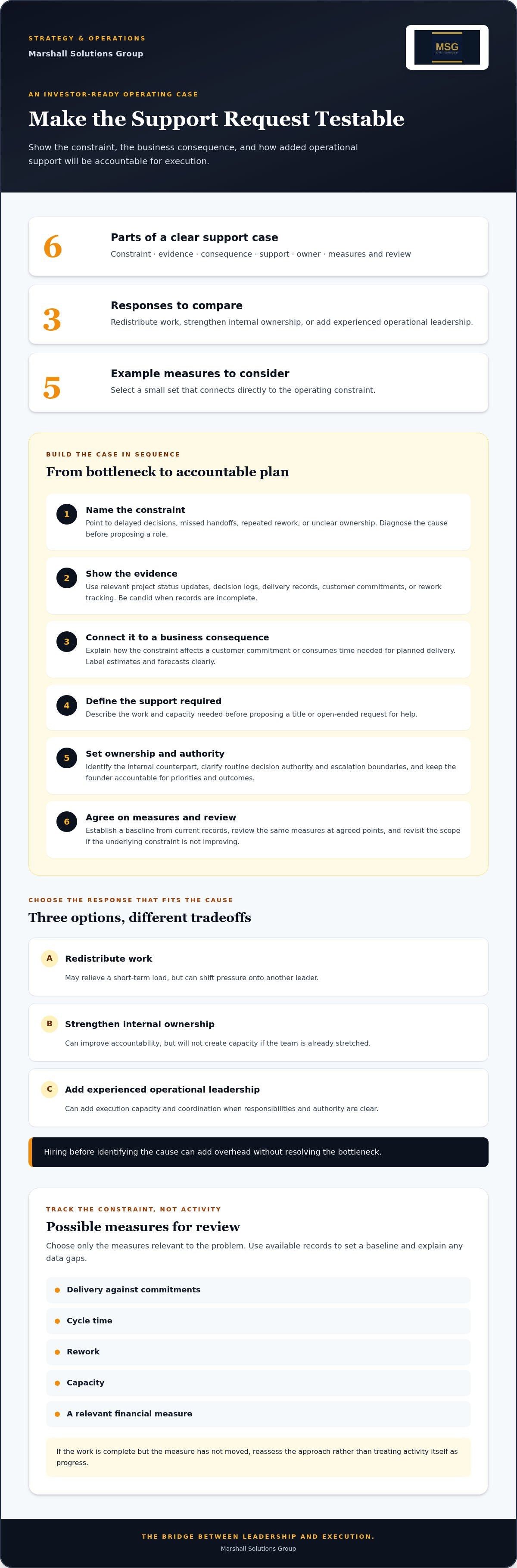
How to build an investor case for operational support
Make the request testable, not open-ended. Present it in sequence: the constraint, the evidence gathered, the business consequence, the support required, the internal owner, and the measures and review point. Investors can then assess whether the proposed support addresses the operating problem rather than simply adding overhead.
Choose the response that fits the cause. Redistributing work may relieve a short-term load, but it can push pressure onto another leader. Strengthening internal ownership can improve accountability, though it won’t create capacity if the team is already stretched. Experienced operational leadership can add execution capacity and coordination, but only if authority and responsibilities are clear. Define the work before proposing a role.
What should an investor-ready support plan include?
Specify the work, decision authority, accountable internal leader, and review point. For example, clarify which routine decisions the operational lead can make, which issues must be escalated, and who resolves conflicts with existing priorities. The founder remains responsible for company priorities and outcomes; support should have authority to execute its assigned work, not replace leadership.
Select a small set of existing measures tied to the constraint, such as delivery against commitments, cycle time, rework, capacity, or a relevant financial measure. Use current records to establish a baseline, and explain any gaps in the data. Review the same measures at agreed points. If activity isn’t improving the underlying constraint, revisit the scope or approach rather than treating activity itself as progress.
This makes the case for operational support specific and accountable. For guidance on aligning operating priorities with execution, explore Strategy & Operations Consulting.
Addressing Investor Concerns: From Approval to Execution
Investors may reasonably question whether added operational support will become overhead without improving execution. Don’t promise automatic growth. Show how the support will address a defined constraint, who will direct the work, and how you’ll know whether it is helping. Approval is only the starting point. Unclear authority or overlapping responsibilities can leave the original bottleneck intact while adding cost and confusion.
How can founders show that support is accountable rather than added overhead?
Set a clear remit and decision boundaries before work begins. Name an internal counterpart who owns coordination and retains responsibility for company outcomes. Agree on a review schedule and examine the measures tied to the original constraint. If the work is complete but the measure hasn’t moved, reassess the approach rather than defending activity for its own sake.
Embedded delivery can keep operational support engaged through implementation, not just recommendations. Marshall Solutions Group’s model emphasizes staying through implementation with aligned incentives. That does not guarantee a particular investor outcome; it makes ownership and follow-through visible. The same logic applies to operational leadership: scope the role around execution needs, then assess its contribution against relevant business measures. For related considerations, see the discussion of fractional COO return on investment.
A credible answer to how to convince investors you need operational help includes a plan for what happens after approval: who has authority, where leadership stays accountable, and when everyone reviews progress. Marshall Solutions Group helps organizations assess operating constraints and align leadership, processes, and execution. The company’s leadership team brings 60+ combined years of experience across military command, Fortune 500 operations, organizational transformation, and federal programs. To learn more about the firm, visit Marshall Solutions Group on LinkedIn.
Turn the Support Request Into an Execution Plan
Investors can assess operational support more clearly when the request defines the problem and the response. Identify the constraint, show its effect on delivery or business performance, then define the work, decision boundaries, accountable leader, and review measures. The point isn’t to promise automatic growth. It’s to make execution risk visible and establish how leadership will track whether the response is working.
That’s the practical case for how to convince investors you need operational help: connect the support to a real operating need while keeping founder accountability clear. Marshall Solutions Group’s approach emphasizes embedded delivery through implementation, with aligned incentives.
If you’re preparing this conversation, discuss the operational constraint behind your investor conversation. A clearly scoped plan gives you and your investors a stronger basis for deciding what happens next.
Frequently Asked Questions
How do you convince investors you need operational help?
To explain how to convince investors you need operational help, identify a specific execution constraint and support it with company evidence. Show the business consequence, define the work and decision authority requested, and name the internal leader who remains accountable. Agree on relevant measures and review points. Present support as a bounded response to a diagnosed need, not a guarantee of growth.
Will investors see operational support as unnecessary overhead?
They may if the request lacks a clear problem, scope, or way to assess progress. Explain which work or decisions are constrained, then compare added operational leadership with redistributing work or strengthening internal ownership. Set a review point and use measures connected to the bottleneck. Don’t promise savings or returns unless your company’s own evidence supports that claim.
What evidence should founders show investors before requesting operational help?
Use relevant internal records, when available, to show recurring delays, decision bottlenecks, missed commitments, or repeated rework. Separate observed facts from forecasts, and connect the evidence to a specific business consequence. Then explain how the proposed support addresses the underlying cause. For example, extra coordination may not resolve delays caused by unclear decision authority.
Should a founder hire an operations leader or improve existing processes first?
Choose based on the root cause. If work is unclear or repeatedly breaks down, clarify process and ownership before adding leadership capacity. If coordination or leadership bandwidth is the constraint, operational leadership may be appropriate. Compare each option against the diagnosed issue, the effort required to implement it, and measures that can show whether execution is improving.
Disclaimer
The information provided in this article is for general informational and educational purposes only and does not constitute legal, financial, accounting, engineering, or other professional advice. Marshall Solutions Group, Inc. makes no representations or warranties regarding the completeness or applicability of this information to any specific situation. Readers should consult appropriately qualified professionals before making decisions requiring specialized professional advice.