Healthcare Organizational Change: A Practical Readiness and Execution Checklist
By CJ Marshall, President & Founder
Manage healthcare organizational change effectively. Use this executive checklist to assess frontline readiness, align leadership, and protect patient safety.

Article by
Chelvis “CJ” Marshall
Chelvis “CJ” Marshall is President and Founder of Marshall Solutions Group, a management consulting firm specializing in Strategy & Operations, Organizational Leadership & Change, and Program & Project Management.
A retired U.S. Navy Senior Chief who advanced from E-1 to E-8 in 10 years, CJ transitioned into Fortune 500 enterprise sales and leadership, generating more than $20 million in commercial sales. He brings extensive operational experience leading teams, managing complex programs, and overseeing mission-critical operations.
His work focuses on bridging leadership and execution, helping organizations translate strategic priorities into disciplined execution, organizational accountability, and measurable business outcomes.
A change plan isn’t ready just because leaders have announced it. In healthcare, a new process can look sound on paper and still conflict with staffing demands, established workflows, or patient-safety priorities. Healthcare organizational change is more likely to hold when leaders connect the intended outcome to the work teams must carry out every day.
Leaders may know change is necessary, but making it workable without losing sight of safe, reliable operations is harder. This checklist helps you assess readiness before implementation, clarify who owns decisions, establish how frontline feedback reaches leaders, and review adoption alongside operational effects. It also addresses a common failure point: treating communication as proof of alignment. Before moving ahead, check whether teams have the capacity, support, and clear direction to put the change into practice.
Key Takeaways
- Define the intended patient-safety or operational outcome before setting implementation tasks. Completed activities alone don’t show that a change is working.
- Use a healthcare organizational change readiness check to surface gaps in leadership agreement, frontline capacity, training, and staff feedback routes.
- Clarify decision rights and ownership so teams know who can resolve barriers and where concerns should go.
- Review adoption alongside relevant operational and patient-safety indicators. Investigate missed adoption before deciding how to adjust the plan.
Table of Contents
Healthcare Organizational Change: Define the Change Before Asking Teams to Adopt It
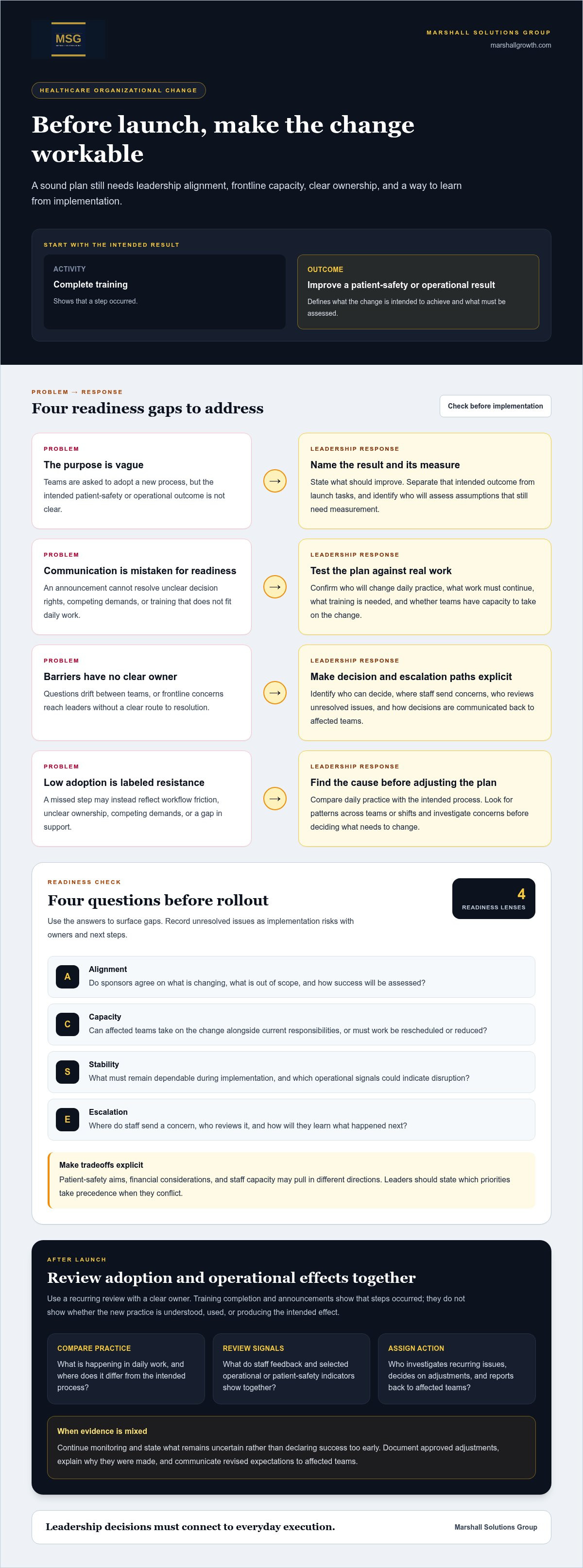
Healthcare organizational change is a deliberate shift in roles, processes, priorities, or ways of working. Before asking staff to adopt it, define the intended result: a patient-safety outcome, an operational improvement, or both. “Complete training” and “launch the new process” describe activities, not evidence that care or operations improved.
This distinction matters in healthcare administration because organizational decisions affect the work of clinical and operational teams. State the goal plainly, then distinguish it from effects that are expected but not yet demonstrated. For example, a proposed process change might aim to reduce handoff delays. Whether delays decrease is an outcome to measure, not an assumption to present as fact.
For another broad perspective on the field, see Healthcare administration.
This video discusses organizational change management in healthcare:
What leaders should clarify before launching a change
Set the boundaries before implementation begins. Name what will change, who will experience it, and which existing responsibilities must continue during the transition. Identify who can make decisions when questions arise and which frontline roles will carry out the new process. Without clear ownership, unresolved issues can drift between teams or wait for decisions no one knows how to make.
Separate known constraints from assumptions in the planning record. Staffing availability and required coordination may be known constraints; expected time savings or smoother handoffs remain assumptions until measured. In a hypothetical workflow change, for example, don’t treat an anticipated reduction in duplicate work as an established result.
- Write down the intended patient-safety or operational outcome.
- Record assumptions that require measurement and identify who will assess them.
- Specify what work must continue and who owns implementation decisions.
Healthcare Organizational Change Checklist: Test Readiness, Capacity, and Alignment
A change is ready to launch when leaders agree on its purpose and the people expected to carry it out have a workable path to do so. In healthcare organizational change, a communication plan cannot compensate for unclear decision rights, competing demands, or training that doesn’t fit the work.
Use this readiness check to make gaps visible before they become implementation problems. AHRQ’s Change Management in Healthcare also describes a structured approach to change in healthcare settings.
A practical readiness check for healthcare leaders
Ask sponsors to explain the purpose, boundaries, decision ownership, and success measures in consistent terms. Then test the plan against frontline conditions: who changes daily practice, what work must continue, what training is needed, and how staff can raise concerns. Identify who receives unresolved issues, who has authority to act, and how decisions will be communicated back to the affected teams.
- Alignment: Do sponsors agree on what is changing, what is out of scope, and how success will be assessed?
- Capacity: Can affected teams take on the change alongside current responsibilities, or must work be rescheduled or reduced?
- Stability: What must remain dependable during implementation, and what operational signals could indicate disruption?
- Escalation: Where do staff send a concern, who reviews it, and how will they learn what happened next?
Make tradeoffs explicit. Patient-safety aims, financial considerations, and staff capacity may pull in different directions. Leaders should state which priorities take precedence when they conflict, rather than leaving frontline teams to resolve that tension on their own.
Record gaps in agreement, training, or capacity as implementation risks with owners and next steps. Don’t label a concern resistance before understanding its cause. It may point to an unclear instruction, a workload conflict, or a decision that has not been made. Structured change planning helps leaders address those conditions before rollout.
Keep Healthcare Organizational Change on Track Through Feedback and Adjustment
Implementation needs a review rhythm, not a single launch check. For healthcare organizational change, compare what teams are doing with the intended practice, then review staff feedback alongside relevant operational or patient-safety indicators. Training completion and announcements show that steps occurred. They don’t show whether the new way of working is understood, used, or producing the intended effect.
Use implementation feedback to decide what happens next
Set a recurring review with a clear owner and a route for frontline concerns. Look for patterns across teams or shifts, while responding promptly to an individual issue that may signal a safety concern. A missed step could reflect workflow friction, unclear ownership, competing demands, or a gap in support. Diagnose the cause before treating low adoption as unwillingness.
- Compare practice: What is happening in daily work, and where does it differ from the intended process?
- Review signals: What do staff feedback and selected operational or patient-safety indicators show together?
- Assign action: Who will investigate recurring issues, decide on adjustments, and report back to affected teams?
When evidence supports a change, document what was adjusted, who approved it, and why. Explain the revision to affected teams so they aren’t left following outdated instructions or guessing whether expectations have shifted. If the evidence is mixed, continue monitoring and state what remains uncertain rather than declaring success too early.
Disciplined follow-through connects leadership decisions to everyday execution. Marshall Solutions Group’s Organizational Leadership & Change capability supports organizations in aligning leadership, teams, and implementation. That work depends on clear ownership, reliable feedback routes, and decisions teams can act on.
Make the Next Change Easier to Execute
Use each change to strengthen the organization’s ability to handle the next one. Review what the experience revealed about decision-making, coordination, and how work moves across teams. Carry those lessons into future planning, including unresolved handoffs, unclear ownership, or capacity constraints. This turns implementation into more than a single effort and helps leaders improve how the organization manages change.
Organizational Leadership & Change is a Marshall Solutions Group capability. MSG stays involved through implementation, with aligned incentives focused on carrying the work forward.
Explore Organizational Leadership & Change to discuss how implementation support could fit your organization’s priorities.
Frequently Asked Questions
What is organizational change in healthcare?
Organizational change in healthcare alters how an organization assigns work or coordinates decisions. A hypothetical example is shifting discharge-planning coordination from individual departments to a shared cross-functional role. Leaders should map the connected workflows affected, including dependencies between teams, so the change is understood as more than a new task or tool.
Why does organizational change fail in healthcare?
Healthcare change can falter when a process designed for one unit depends on another team’s sequence, handoff, or exception path that wasn’t considered. A rollout may also stall if local supervisors are expected to resolve conflicts without authority. Treat these as possibilities to investigate: trace work across departments and identify where responsibilities or assumptions break down.
How can healthcare leaders assess readiness for organizational change?
Before a broad rollout, test the proposed process with a representative scenario. Trace how work would move across roles, including an exception rather than only the routine path. Note where instructions become ambiguous or one team depends on an action another team hasn’t planned. Resolve these design gaps before staff are expected to rely on the new process.
How should leaders measure healthcare organizational change?
Establish a pre-launch reference point and decide in advance how results will be interpreted. Pair an early signal, such as whether the new procedure is being used as designed, with a later result tied to its purpose. Where appropriate, examine variation by unit or shift. An organization-wide average can hide a local problem or a benefit limited to one area.
Disclaimer
The information provided in this article is for general informational and educational purposes only and does not constitute legal, financial, accounting, engineering, or other professional advice. Marshall Solutions Group, Inc. makes no representations or warranties regarding the completeness or applicability of this information to any specific situation. Readers should consult appropriately qualified professionals before making decisions requiring specialized professional advice.