Operational Performance Improvement: Turn Diagnosis Into Execution
By CJ Marshall, President & Founder
True operational performance improvement targets the constraint, not symptoms. Learn how to diagnose bottlenecks, assign clear ownership, and fix execution.

Article by
Chelvis “CJ” Marshall
Chelvis “CJ” Marshall is President & Founder of Marshall Solutions Group, a management consulting firm specializing in Strategy & Operations, Organizational Leadership & Change, and Program & Project Management. A retired U.S. Navy Senior Chief who advanced from E-1 to E-8 in 10 years, CJ transitioned into Fortune 500 enterprise leadership, where he personally generated $20 million in career sales. He has led organizations of up to 400 personnel, overseen complex engineering operations, and managed mission-critical programs. His work focuses on bridging leadership and execution—helping organizations translate strategic direction into disciplined execution, stronger accountability, and measurable business results.
Another improvement initiative won’t fix an operation that hasn’t identified what is slowing work down. Missed deadlines, rework, and growing backlogs are visible symptoms. The constraint may be unclear decision rights, an approval bottleneck, or a process that no longer fits the work. Operational performance improvement starts with finding the cause, not launching another broad effort.
Daily delivery competes with change, so improvement has to fit the organization’s real capacity and priorities. The aim is not to add activity. It is to remove the constraint that most affects performance, assign clear ownership, and track whether execution improves. This article explains how to diagnose a constraint, choose a practical response, and keep the work moving without losing accountability.
Key Takeaways
- Separate visible problems, such as delays and rework, from the underlying constraint before choosing a fix.
- Use operational performance improvement to target the issue with the greatest effect, while accounting for implementation effort, risk, and leadership capacity.
- Bound the first change so the team can test whether it addresses the cause without overloading daily delivery.
- Assign a clear owner, decision rights, and a review rhythm, then track a small set of measures tied to the work.
Table of Contents
Operational performance improvement starts by finding the constraint behind the symptoms
Operational performance improvement means deliberately changing how work is led, organized, or delivered so the organization can perform more reliably. It is not indiscriminate cost cutting. It targets barriers to effective work while protecting the capacity and quality the business depends on. Cutting expense without understanding the work can shift costs elsewhere, add delays, or increase rework.
A missed deadline is a symptom, not a diagnosis. The cause might be unclear decision ownership, a handoff that routinely stalls, or more work assigned than a team can complete. Trace the work from request to completion and identify where it waits, gets returned, or requires an escalation. The basic idea of operational efficiency is relevant, but leaders still need to determine which specific constraint is affecting their organization.
This video offers a perspective on connecting improvement efforts into a sustained program:
How to tell a persistent operating constraint from a one-off problem
Look for a recurring pattern across jobs, teams, or handoffs. Does the same approval wait on one person? Do similar tasks repeatedly return for correction? A single disruption may be exceptional; a pattern suggests something in the operating system needs attention. Compare where work waits, where decisions collect, and where capacity runs short before settling on a cause.
Then ask which constraint most directly affects delivery, capacity, quality, or margin. A suspected bottleneck is a hypothesis until the work supports it. Review timelines, handoffs, and examples of completed work with the people closest to the process. If the evidence does not fit the explanation, revise the diagnosis. A credible starting point is more useful than a fast fix aimed at the wrong problem.
Choose an operational improvement that fits the impact, risk, and capacity
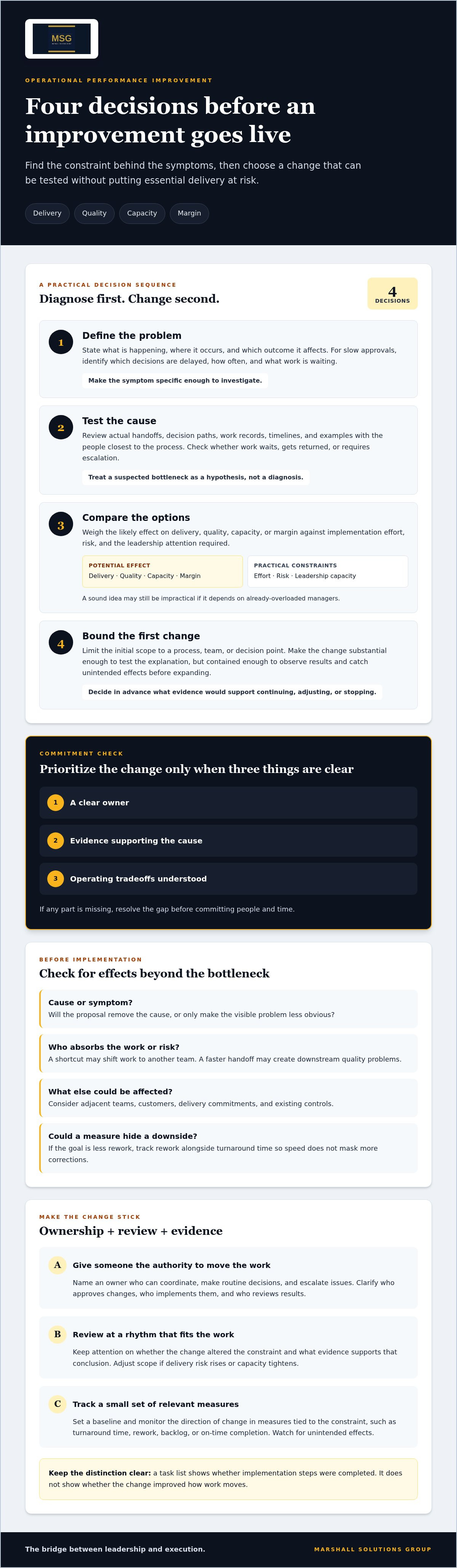
The strongest improvement is not necessarily the largest or most visible. Choose a change that addresses a supported cause, matters to business performance, and can be implemented without putting essential delivery at risk. Operational performance improvement requires disciplined choices, especially when the same leaders must manage daily work and guide change.
- Define the problem. State what is happening, where it occurs, and which outcome it affects. “Approvals take too long” is a starting point. Identify which decisions are delayed, how often the delay occurs, and what work waits.
- Test the cause. Examine actual handoffs, decision paths, and work records. Do not assume a new tool, policy, or staffing adjustment will solve the issue until the evidence supports that explanation.
- Compare options. Weigh the likely effect on delivery, quality, capacity, or margin against effort, risk, and the leadership attention required. A change that depends on already-overloaded managers may be impractical, even if the idea is sound.
- Bound the first change. Limit the initial scope to a process, team, or decision point where the organization can observe what changes and catch unintended effects before expanding.
Decision rule: Prioritize a change only when its owner, supporting evidence, and operating tradeoffs are clear. If one is missing, resolve the gap before committing people and time.
What leaders should test before committing to a change
Check whether the proposal removes a cause or merely makes a symptom less visible. Then consider who else may absorb the work. An approval shortcut could shift risk to another team, while a faster handoff could create quality problems downstream. Assess effects on adjacent teams, customers, delivery commitments, and existing controls. A deeper operational performance assessment guide can help structure that diagnosis before resources are committed.
Keep the first change small enough to learn from, but substantial enough to test the explanation. Before starting, define what evidence would support continuing, adjusting, or stopping the effort. For example, if the change is intended to reduce rework, monitor rework alongside turnaround time so a faster process does not appear successful while creating more corrections downstream.
Sustain operational performance improvement through ownership and follow-through
A change becomes part of the operation only when someone is accountable for putting it into practice and resolving barriers. Name an owner with enough authority to coordinate the work, make routine decisions, and escalate issues beyond their remit. Clarify who approves changes, who carries them out, and who reviews the result. Without those decision rights, even a sound process can stall between teams.
Set a review rhythm that fits the work. Use a small number of measures tied to the original constraint, such as turnaround time, rework, backlog, or on-time completion. Establish a baseline, then look at the direction of change and any unintended effects rather than imposing a universal target. A task list can show whether implementation steps were completed; it cannot show whether the change improved how work moves.
Keep implementation accountable without adding bureaucracy
Keep the review focused: Did the change alter the constraint, and what evidence supports that conclusion? If delivery risk rises or competing priorities reduce available capacity, adjust the scope rather than asking the team to absorb an unrealistic plan. When adoption is the main obstacle, the change management and process improvement guide examines the people and process factors involved.
Disciplined follow-through takes leadership time. Marshall Solutions Group provides embedded leadership and operating support to help organizations carry improvement through implementation, keeping ownership and execution connected to daily operations. To explore how MSG’s strategy and operations work could support an improvement effort, discuss the constraint your organization is working to resolve.
Make the next improvement part of how the business runs
As the business grows, leaders need to decide which operating capabilities must develop alongside it. That forward-looking view keeps improvement connected to the organization’s direction instead of treating each operational challenge as an isolated fix. It also helps leaders distinguish a temporary workaround from a capability the organization needs to build and maintain.
Marshall Solutions Group brings practical leadership experience to strategy and execution. Its leadership team has 60+ combined years of experience across military command, Fortune 500 operations, organizational transformation, and federal programs. That experience informs the work; results still depend on the organization’s context, decisions, and execution.
If your organization is deciding what to strengthen next, discuss an operational challenge with Marshall Solutions Group. A focused conversation can help clarify where operational performance improvement fits the business’s next stage.
Frequently Asked Questions
Is operational performance improvement the same as cost cutting?
No. Cost cutting is one possible financial objective; operational improvement examines how work is performed and whether it supports the organization’s priorities. For a hypothetical example, removing duplicate data entry may reduce effort, while the larger value could be using that time for work customers need. Judge the change by its operational purpose, not only by whether it reduces spending.
Can operational performance improve without a major reorganization?
Yes. A reorganization is one way to address a structural problem, but it can create disruption without resolving the work itself. Leaders may be able to make progress by changing a local procedure, clarifying a role’s scope, or adjusting how a team sequences its workload. Consider a broader redesign when the problem crosses organizational boundaries or existing responsibilities consistently obstruct decisions.
What should leaders do when an improvement effort conflicts with daily delivery?
Make the priority decision explicit rather than leaving teams to choose between customer commitments and improvement work on their own. The executive sponsor should decide what work can be deferred, what delivery cannot slip, and who has authority to resolve conflicts. If no activity can be displaced, the organization has not allocated capacity for the change and should revisit its timing.
How can leaders tell whether an operational improvement is holding?
Check whether the change is built into the operating infrastructure, not sustained only by a temporary project team. Look for updated procedures, role expectations, onboarding materials, and routine management conversations that reflect the new method. If staff still need an outdated document or a parallel workaround, the change has not been fully incorporated into how the organization operates.
Disclaimer
The information provided in this article is for general informational and educational purposes only and does not constitute legal, financial, accounting, engineering, or other professional advice. Marshall Solutions Group, Inc. makes no representations or warranties regarding the completeness or applicability of this information to any specific situation. Readers should consult appropriately qualified professionals before making decisions requiring specialized professional advice.