Accountability Framework for Leadership Teams: Build Alignment
By Chelvis “CJ” Marshall, President & Founder
An accountability framework for leadership teams clarifies ownership, expectations, and follow-through. See how the Five Cs align priorities and drive results.

Article by
Chelvis “CJ” Marshall
Chelvis "CJ" Marshall is President and Founder of Marshall Solutions Group (MSG), a veteran-owned management consulting firm helping organizations strengthen leadership, improve operations, and turn strategy into disciplined execution. MSG specializes in Organizational & Operational Improvement, Growth Strategy & Business Development, and Program & Project Management.
A retired U.S. Navy Senior Chief, CJ served as the senior enlisted engineering leader aboard USS McCampbell (DDG-85), overseeing a 137-person engineering department responsible for mission-critical shipboard systems. He subsequently advanced into Fortune 500 enterprise sales and leadership, bringing operational discipline and commercial experience to complex business environments. He is completing his MBA at Syracuse University's Whitman School of Management.
CJ's approach reflects a central principle: strategy creates direction, but leadership, accountability, and disciplined execution determine whether organizations can deliver. His work focuses on helping leadership teams establish the structures, operating practices, and management discipline needed for sustained performance.
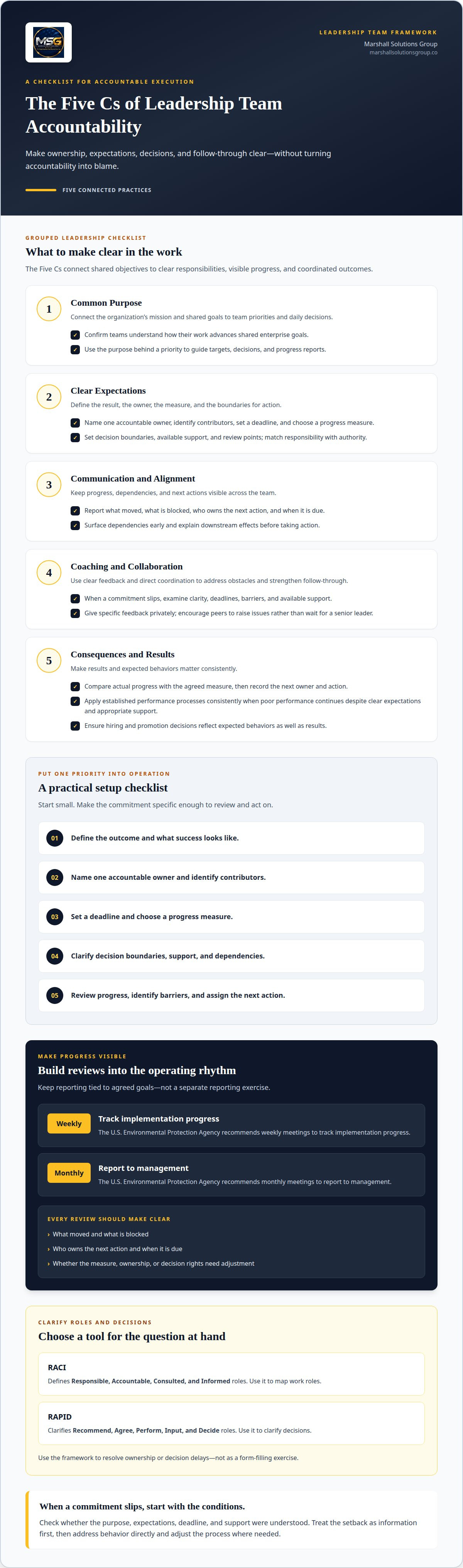
A leadership team struggles to deliver consistent results when ownership, expectations, and follow-through remain implicit. An accountability framework for leadership teams makes them clear: who owns each outcome, how progress is measured, who makes decisions, and when results are reviewed. The Five Cs are Common Purpose, Clear Expectations, Communication and Alignment, Coaching and Collaboration, and Consequences and Results.
Leaders know goals matter, but priorities often fail to translate into coordinated action. This framework connects shared objectives to clear responsibilities and regular communication without turning accountability into blame. When a commitment slips, it helps leaders examine whether the goal was clear, the deadline realistic, and the necessary support available. The sections ahead explain each C, show how the framework sets goals and makes progress visible, and describe how communication and alignment help leadership teams catch gaps before they disrupt execution.
Key Takeaways
- Clarify who owns each outcome, how progress will be measured, and when the team will review it.
- Connect organizational goals to team priorities, then communicate expectations consistently across the organization.
- Use the Five Cs to set direction, delegate with clear boundaries, and address missed commitments constructively.
- When accountability gaps disrupt execution, management consulting and implementation support can help align leadership responsibilities with operational priorities.
Table of Contents
Definition and Goals of an Accountability Framework
An accountability framework for leadership teams defines how work is owned, outcomes measured, decisions made, and progress reviewed. It connects company priorities to clear owners and visible results, allowing teams to make decisions within agreed boundaries.
Start with one priority. Define the outcome, name one accountable owner, identify contributors, set a deadline, and choose a progress measure. For example, a manager responsible for customer handoffs needs a shared definition of a completed handoff. Review missed transitions in the operating meeting, then assign a corrective action. Clear expectations make behavior observable and give managers something specific to coach.
Common failure modes include shared responsibility without a final decision owner. Activity measures can obscure missed outcomes, while inconsistent consequences weaken trust. The framework may also stall when leaders set expectations without providing resources or expect incentives alone to change established behavior. Senior leaders need to support the change and ensure decision authority matches responsibility.
Build accountability into managers’ regular routines rather than creating a separate reporting exercise. In each review, compare the agreed measure with actual progress, ask what blocked delivery, and record the next owner and action. Treat a setback as information first: examine whether the purpose, expectations, deadlines, and support were understood. Then address behavior directly and adjust the process where needed. This builds a culture where commitments are visible, follow-through is expected, and learning informs better decisions.
Communication and Alignment
Communication links the organization’s mission to organizational goals, team priorities, and daily decisions. Without that connection, teams may meet local targets while missing the purpose behind them.
Organizational Alignment
Organizational alignment means teams understand how their work advances the mission and shared organizational goals. For example, a customer-retention priority should shape service targets, team decisions, and progress reports across functions. This connection helps employees see how their responsibilities contribute to organizational success instead of treating each target as an isolated task.
Values need practical consequences. During hiring, managers can use consistent, job-related examples to assess whether candidates demonstrate expected behaviors. Promotion decisions should reflect those behaviors, not results alone. If leaders reward one set of values but promote people who disregard them, employees receive conflicting signals about what the organization truly believes.
Meeting Cadence and Reporting Practices
A regular meeting cadence gives leaders dedicated time to communicate progress, surface dependencies, and address risks. The U.S. Environmental Protection Agency recommends weekly meetings to track implementation progress and monthly meetings to report to management. Keep reports tied to agreed goals: what moved, what is blocked, who owns the next action, and when it is due.
Address missed commitments through a consistent, constructive conversation. Compare the result with the stated expectation, then examine barriers, available support, and the employee’s actions. Give specific feedback privately and document agreed next steps. If poor performance continues despite clear expectations and appropriate support, apply the organization’s established performance process consistently. This helps distinguish a fixable obstacle from repeated behavior.
What Are the Five Cs of Leadership and Team Accountability?
The Five Cs are Common Purpose, Clear Expectations, Communication and Alignment, Coaching and Collaboration, and Consequences and Results. Together, they connect delegated work to coordinated outcomes.
Delegating Ownership Without Micromanaging
Delegation gives someone responsibility for an outcome and room to choose how to deliver it. A leader sets the result, decision boundaries, available support, and review points, then avoids directing every task. For example, a manager may own a process improvement while escalating decisions that affect another department. This keeps feedback focused on results and significant risks.
Shared Ownership and Peer Accountability
Shared ownership coordinates contributors around an outcome without obscuring who makes the final decision. In a digital product, a team responsible for one component must consider how its changes affect connected components. Teams should surface dependencies early and explain downstream effects before acting. Peer accountability helps colleagues raise issues directly rather than waiting for a senior leader to discover a preventable handoff failure.
Clarifying Outcomes and Ownership
Clear outcomes describe what success looks like; ownership identifies who can make decisions and take action. The right level of detail depends on organizational size, industry, and how work crosses functions. A small team may clarify ownership in a working discussion, while a complex organization may need explicit decision roles across departments. The principle remains the same: responsibility must match authority.
Tools and Steps for Defining Accountability
RACI defines Responsible, Accountable, Consulted, and Informed roles; RAPID clarifies Recommend, Agree, Perform, Input, and Decide. Use RACI to map work roles and RAPID to clarify decisions. Start with a priority, assign roles, identify measures and dependencies, then review progress and adjust if ownership or decision rights cause delays. The Five Cs should fit the organization’s operating needs, not become a form-filling exercise.
How Marshall Solutions Group Can Help
Marshall Solutions Group helps leadership teams connect accountability principles with management practices that support execution. Leaders may seek support when decision rights are unclear, cross-functional commitments stall, or existing routines no longer fit organizational priorities. The work begins with the issue leaders need to address, not a preset package of services.
An operational assessment can examine how roles, decisions, and operating practices affect performance. Organizational & Operational Improvement can help align business priorities with management routines. Leadership and organizational change support can help clarify shifts in leadership responsibilities or expectations. Program & Project Management can help teams coordinate work, dependencies, and delivery oversight.
Outside support can be useful when leaders need a clearer view of how the organization operates or when teams need help putting agreed changes into practice. The right scope depends on the problem, the decisions involved, and the support leaders want. An assessment can provide a structured starting point; other work can address specific priorities and implementation responsibilities. Deliverables and responsibilities are set out in the agreed scope.
If leadership accountability needs closer examination, explore an Operational Assessment with Marshall Solutions Group.
Put Accountability Into the Work
A framework matters when leaders use it to make decisions, address obstacles, and adjust priorities as conditions change. Start with a commitment the team can observe in daily work. Clarify who can act, what information they need, and how leaders will respond when progress shifts. Use what the team learns to refine the approach.
An accountability framework for leadership teams should support sound judgment, not add reporting for its own sake. If the process creates more updates without helping people coordinate or resolve issues, simplify it. If responsibilities remain unclear, revisit decision rights before adding measures. Consistent leadership behavior is what makes the framework credible.
Make accountability part of how the leadership team works, not another layer alongside the work. When leaders set clear expectations, address obstacles directly, and follow through on decisions, teams can act with greater confidence. Keep the framework practical, adapt it as the organization changes, and reinforce behaviors that support shared results.
Frequently Asked Questions
What Is an Accountability Framework?
An accountability framework is a set of agreed practices that makes responsibility visible and addresses whether commitments are met. For example, a department review might record the decision owner, affected teams, evidence of completion, and any unresolved issue. This helps leaders distinguish a delivery problem from a process gap or a decision that needs escalation.
Executive Summary: What is the Triad of Accountability?
A useful working triad is clarity, ownership, and follow-through. Clarity sets the expected result; ownership identifies who will act; follow-through checks what happened and determines the response. For example, after approving a staffing plan, executives can assign one decision owner, agree on the intended coverage, and revisit the decision if operating needs change.
How do you hold someone accountable without it feeling like an interrogation?
Keep the conversation focused on the work, not the person’s character. Ask what changed, what obstacle affected the commitment, and what action would restore progress. For example, if a report arrives late, clarify the missed expectation, listen to the reason, and agree on a workable next step. Specific, calm feedback reduces defensiveness and keeps responsibility clear.
What is the difference between accountability and consequences?
Accountability means explaining results and taking responsibility for what follows; consequences are responses to actions or outcomes. A consequence might involve additional coaching, a revised approval limit, or formal performance action, depending on the circumstances. Leaders should communicate expectations and likely responses in advance, then apply them consistently rather than treating every setback as misconduct.
What is an accountability framework for leadership teams?
An accountability framework for leadership teams gives executives a shared way to address commitments that cross functional boundaries. For instance, a product launch may depend on sales readiness, customer support preparation, and operational capacity. The framework helps leaders identify stalled dependencies, bring the right decision-makers together, and resolve tradeoffs before a delay in one function causes broader disruption.
Disclaimer
The information provided in this article is for general informational and educational purposes only and does not constitute legal, financial, accounting, engineering, or other professional advice. Marshall Solutions Group, Inc. makes no representations or warranties regarding the completeness or applicability of this information to any specific situation. Readers should consult appropriately qualified professionals before making decisions requiring specialized professional advice.