How to Build a Management Operating System That Aligns Goals and Scales
By Chelvis “CJ” Marshall, President & Founder
Learn how to build a management operating system that links goals to ownership, useful measures, and decision routines, then scale without extra bureaucracy.

Article by
Chelvis “CJ” Marshall
Chelvis "CJ" Marshall is President and Founder of Marshall Solutions Group (MSG), a veteran-owned management consulting firm helping organizations strengthen leadership, improve operations, and turn strategy into disciplined execution. MSG specializes in Organizational & Operational Improvement, Growth Strategy & Business Development, and Program & Project Management.
A retired U.S. Navy Senior Chief, CJ served as the senior enlisted engineering leader aboard USS McCampbell (DDG-85), overseeing a 137-person engineering department responsible for mission-critical shipboard systems. He subsequently advanced into Fortune 500 enterprise sales and leadership, bringing operational discipline and commercial experience to complex business environments. He is completing his MBA at Syracuse University's Whitman School of Management.
CJ's approach reflects a central principle: strategy creates direction, but leadership, accountability, and disciplined execution determine whether organizations can deliver. His work focuses on helping leadership teams establish the structures, operating practices, and management discipline needed for sustained performance.
Growth exposes weak management systems. To understand how to build a management operating system, connect organizational goals to clear ownership, useful measures, and regular decision-making routines. The system should make priorities visible and help teams act on them, not add process for its own sake.
Leaders need a strategy that works beyond the executive team. Translate company goals into team responsibilities, establish a consistent rhythm for reviewing progress, and adjust the system as the organization grows. This article explains what a management operating system includes, how to align it with organizational goals, and how to scale its routines without creating unnecessary bureaucracy.
Key Takeaways
- Translate organizational priorities into clear outcomes, assigned ownership, and measures teams can act on.
- Build a management operating system around shared processes, decision routines, and accountability, not extra bureaucracy.
- Document how work gets done so responsibilities and recurring processes remain clear as the organization grows.
- Review results and emerging risks regularly, then adjust the system as priorities, teams, and operating demands change.
Table of Contents
Aligning organizational goals with the main objective
- Define the main objective before assigning departmental targets. Break the organization’s vision into 3 to 4 outcome-oriented pillars, such as customer retention, delivery reliability, or profitable growth. These pillars give teams a shared frame for decisions. They also make it easier to identify work that consumes capacity without advancing the objective.
- Choose a manageable set of company goals. A small business might align around five to seven goals rather than treating every initiative as equally important. For each goal, name an accountable executive and define the result that will show progress. A goal without an owner is an intention, not a management commitment.
- Connect each department’s work to those priorities. Assign each department 3-5 clear KPIs tied to company goals, then clarify who owns the work and who can make related decisions. For example, a customer-success team may own retention actions, while a product team controls release priorities. The organization’s structure should support those responsibilities, not create handoffs that obscure accountability.
- Build organizational health and continuous improvement into the review cadence. Review goals often enough to catch problems, but keep discussions focused on decisions and barriers. Software can display measures; it cannot resolve unclear authority or conflicting priorities. Ask teams which processes work well together, where work stalls, and what change could improve outcomes and trust. Track the change at the next review.
What is a management operating system?
- Define the system as the framework connecting strategy to daily execution. It establishes how leaders make decisions, assign work, review results, and address problems across departments. Software can support these routines, but it is not the system itself. To build a management operating system, define the operating rules first, then choose tools that support them.
- Set an ambitious long-range objective, sometimes called a big, hairy, audacious goal. Then define a “leadership gold star”: the observable standard leaders should meet while pursuing it. For example, a company aiming to lead its market might expect leaders to raise delivery risks early and make decisions close to the work.
- Match responsibilities to authority and skills. For each recurring decision, identify the role that owns it, the people who contribute, and who resolves disagreements. Compare the skills required with current capabilities. A department lead accountable for customer retention, for instance, needs authority to address service problems.
- To start from scratch, document current decision paths, select strategic priorities, assign owners, and establish performance measures. Define each KPI with a clear calculation, data owner, and target tied to the intended outcome. A delivery goal, for example, needs a measure of completed work, not just activity.
- Choose tools that make goals, metrics, decisions, and review actions visible in a shared workflow. Spreadsheets or existing project software can work when teams use consistent definitions and clear ownership. Costs depend on the system’s scope, tools, and implementation support. Timing depends on the design, documentation, and change adoption the organization needs.
Scaling a management operating system for growth
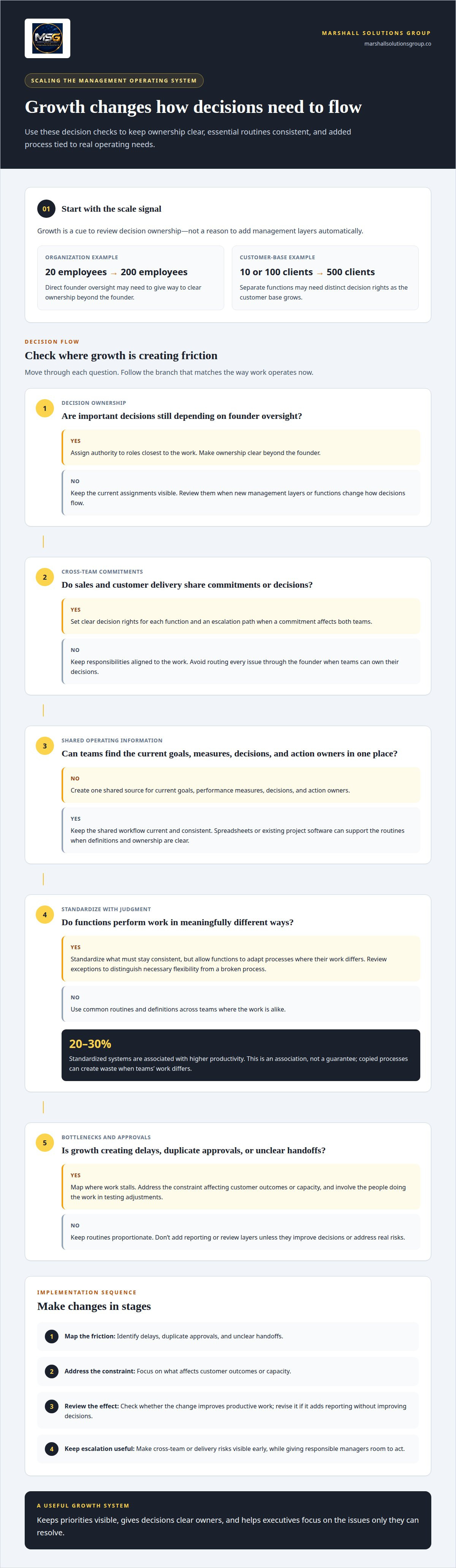
- Keep the operating system useful as the organization expands. A company with 20 employees may rely on direct founder oversight; at 200 employees, decisions need clear ownership beyond the founder. Preserve the same priorities, but assign authority to roles closest to the work. Review these assignments when new management layers or functions change how decisions flow.
- Scale structure with the work, not with titles alone. As a customer base grows from 10 or 100 clients to 500, separate functions may need distinct decision rights. For example, customer delivery and sales can coordinate through shared commitments without routing every issue through the founder. Make escalation paths clear when a commitment affects both teams.
- Standardize essential routines across the organization. Keep one source for current goals, performance measures, decisions, and action owners. Standardized systems are associated with 20-30% higher productivity, but copied processes can create waste when teams’ work differs. Define what must stay consistent and what each function can adapt. Review exceptions to determine whether they reflect necessary flexibility or a broken process.
- Implement changes in stages. First, map where growth creates delays, duplicate approvals, or unclear handoffs. Then address the constraint affecting customer outcomes or capacity. Review whether the change improves productive work, and revise the process if it adds reporting without improving decisions. Involve the people doing the work in identifying friction and testing adjustments.
- Protect the vision while making room for operational excellence. As leaders delegate, set escalation rules for risks that cross teams or threaten delivery. A useful growth system makes problems visible early, gives responsible managers room to act, and keeps executives focused on decisions only they can make. Check that new review layers address real risks rather than slowing routine decisions.
Marshall Solutions Group
We help leadership teams address management challenges that interfere with organizational performance. Our work can focus on leadership, operating practices, or the execution of complex initiatives.
Depending on the need, our support may include organizational and operational improvement, growth strategy and business development, or program and project management. Responsibilities and deliverables are established in the agreed scope for each engagement.
Our support is most relevant when leaders need help clarifying a problem, setting practical changes, or carrying them into implementation. The scope should match the organization’s actual operating challenge.
Put the operating system to work
A management system earns its place when it helps leaders make better decisions as conditions change. The next move is not adding another meeting or dashboard. Identify where execution breaks down, then determine whether ownership, decision flow, or team capability is the constraint. Keep improvement focused on the work, not the appearance of control. Assign someone to own the next change and make its effect visible in normal operating reviews.
For leaders deciding how to build a management operating system that lasts, Marshall Solutions Group can support the work through organizational and operational improvement, growth strategy and business development, or program and project management. The right support depends on the challenge and agreed scope, whether priorities need clarification or teams need help embedding new ways of working.
Discuss your operating challenges with Marshall Solutions Group. Start with the issue that most limits execution, and move forward with a clear next step.
Frequently Asked Questions
I'm busy with real problems, how can I find time for this?
Start with a meeting or review your team already has rather than adding a new one. Pick a recurring problem, such as delayed approvals, and trace where it gets stuck. Agree on one change, assign an owner, and revisit the result during the existing meeting. This keeps system design connected to actual work instead of turning it into another project.
What is a management operating system, and what are its core components?
It is the practical structure leaders use to turn priorities into coordinated work. Core components include decision rules, role expectations, measures, meeting routines, and a process for resolving barriers. Consider a missed delivery: the system should make clear who reports the issue, who decides on recovery, and how affected teams learn from it without relying on informal workarounds.
How do you assess an organization's needs before designing a management operating system?
Examine how work moves from commitment to completion. Trace a recent missed deadline or customer escalation through the decisions, handoffs, and information involved. Compare written procedures with what employees actually do, and note where authority is unclear or duplicate reviews occur. This reveals whether the root issue is process design, capacity, communication, or ownership.
How do meeting rhythms, agendas, and decision rights fit into a management operating system?
Each meeting should serve a defined purpose and produce a clear decision or action. Put exceptions, unresolved dependencies, and decisions requiring leadership attention on the agenda. Share routine updates before the meeting to preserve discussion time for issues that need judgment. Document the decision owner and follow-up responsibility so the same issue does not cycle through multiple meetings.
How do you assign roles, responsibilities, and accountability across teams?
For each important outcome, identify one person accountable for completion, then name contributors and decision-makers. For example, a service manager may own resolving customer complaints, while finance supplies relevant account information. Clarify which decisions the owner can make independently and which require escalation. Review assignments when workflows or team responsibilities change, rather than relying on titles alone.
Disclaimer
The information provided in this article is for general informational and educational purposes only and does not constitute legal, financial, accounting, engineering, or other professional advice. Marshall Solutions Group, Inc. makes no representations or warranties regarding the completeness or applicability of this information to any specific situation. Readers should consult appropriately qualified professionals before making decisions requiring specialized professional advice.