How to Define Leadership Team Roles by Accountability and Authority
By Chelvis “CJ” Marshall, President & Founder
Define the roles and responsibilities of a leadership team by clarifying ownership, decision authority, and expertise so leaders can act and deliver results.

Article by
Chelvis “CJ” Marshall
Chelvis "CJ" Marshall is President and Founder of Marshall Solutions Group (MSG), a veteran-owned management consulting firm helping organizations strengthen leadership, improve operations, and turn strategy into disciplined execution. MSG specializes in Organizational & Operational Improvement, Growth Strategy & Business Development, and Program & Project Management.
A retired U.S. Navy Senior Chief, CJ served as the senior enlisted engineering leader aboard USS McCampbell (DDG-85), overseeing a 137-person engineering department responsible for mission-critical shipboard systems. He subsequently advanced into Fortune 500 enterprise sales and leadership, bringing operational discipline and commercial experience to complex business environments. He is completing his MBA at Syracuse University's Whitman School of Management.
CJ's approach reflects a central principle: strategy creates direction, but leadership, accountability, and disciplined execution determine whether organizations can deliver. His work focuses on helping leadership teams establish the structures, operating practices, and management discipline needed for sustained performance.
A leadership team should be built around the decisions and outcomes the business needs, not titles alone. The roles and responsibilities of a leadership team should make clear who owns each result, who has authority to decide, and who contributes expertise. Leadership teams typically include 3-7 people accountable for the overall business, but the right size depends on the organization’s needs.
It’s easy to assume capable executives will sort out their responsibilities as they go. In practice, unclear ownership can slow decisions and leave important work without a clear lead. This article explains how to align responsibilities with leaders’ skills, assign accountability and decision authority, and communicate roles so the team can work effectively.
Key Takeaways
- Assign leadership responsibilities based on the skills and knowledge each person brings, not title alone.
- Make decision authority clear so leaders know when they can act and when they need input.
- Give each significant initiative one accountable owner, even when several people contribute to the work.
- Communicate role expectations across the team and revisit them when responsibilities or organizational needs change.
Table of Contents
Aligning responsibilities with team members’ skills and knowledge
Start by matching business priorities to leaders’ relevant expertise and decision authority. Adjust assignments as the organization’s structure and needs change.
-
Account for Organization Size and Industry
Map responsibilities to the organization’s current size and operating demands. Don’t treat 3-7 people as a standard leadership-team size; the appropriate size depends on the organization’s needs. Reassess roles when growth changes how decisions get made. For example, an organization growing from 20 or 30 people to 100 may need clearer ownership across functions. Industry also matters: assign leadership attention to the capabilities and risks most central to that business.
-
Compare Leadership Structure Models
Choose a structure that reflects how work and decisions flow. In a functional model, leaders own areas such as finance or operations. A divisional model organizes leadership by product, market, or business unit. A matrix model shares authority across functions and initiatives, making clear decision rights especially important. Compare models by asking where expertise sits and where work crosses boundaries. Choose the structure that supports the work, not one for its label.
-
Define CEO and Executive Team Responsibilities
Define the CEO’s role around overall direction, priority-setting, and decisions requiring enterprise-wide authority. Give executive leaders responsibility for their areas while making shared business outcomes explicit. For each priority, match the work to a leader’s experience and specify what they can decide independently. Distinguish consultation from ownership. If two executives appear accountable for one result, clarify who makes the final decision and who provides expertise.
Communicating roles to improve teamwork and decision-making
Document role expectations alongside decision processes, then apply them consistently. Resolve disagreements using agreed authority, evidence, and business priorities.
-
Clarify Leadership Team Responsibilities
Document who owns each decision, deliverable, and outcome. Unclear responsibilities can lead to duplicated work, missed tasks, and delayed decisions. Conflict also persists when leaders assume authority is shared but nobody has final decision rights. Identify the specific disagreement, hear relevant perspectives, and resolve it through the agreed authority structure. Record the decision and communicate its impact to affected leaders.
-
Communicate Roles Across the Team
Explain responsibilities in plain language, including where leaders must coordinate. The University of Minnesota recommends clarifying and communicating roles to help reduce conflict and improve teamwork and decisions. Its exercise asks participants to spend 2-3 minutes writing peers’ primary responsibilities at their charts. Compare the responses. Differences reveal where expectations are unclear, overlapping, or misunderstood. Discuss each gap directly, then update the role description.
- Repeat the discussion after a major unit or department change. The University of Minnesota recommends using its roles exercise then, helping the group establish a new normal. The exercise takes 1-2 hours and suits groups under 10 people. Assign a note taker to capture key takeaways and email them afterward. Appointing a devil’s advocate can challenge assumptions and surface risks before the team settles on its approach.
Effective team leaders communicate clearly and listen actively. This helps colleagues raise concerns and align expectations as responsibilities shift.
Defining roles by outcomes, accountability, and authority
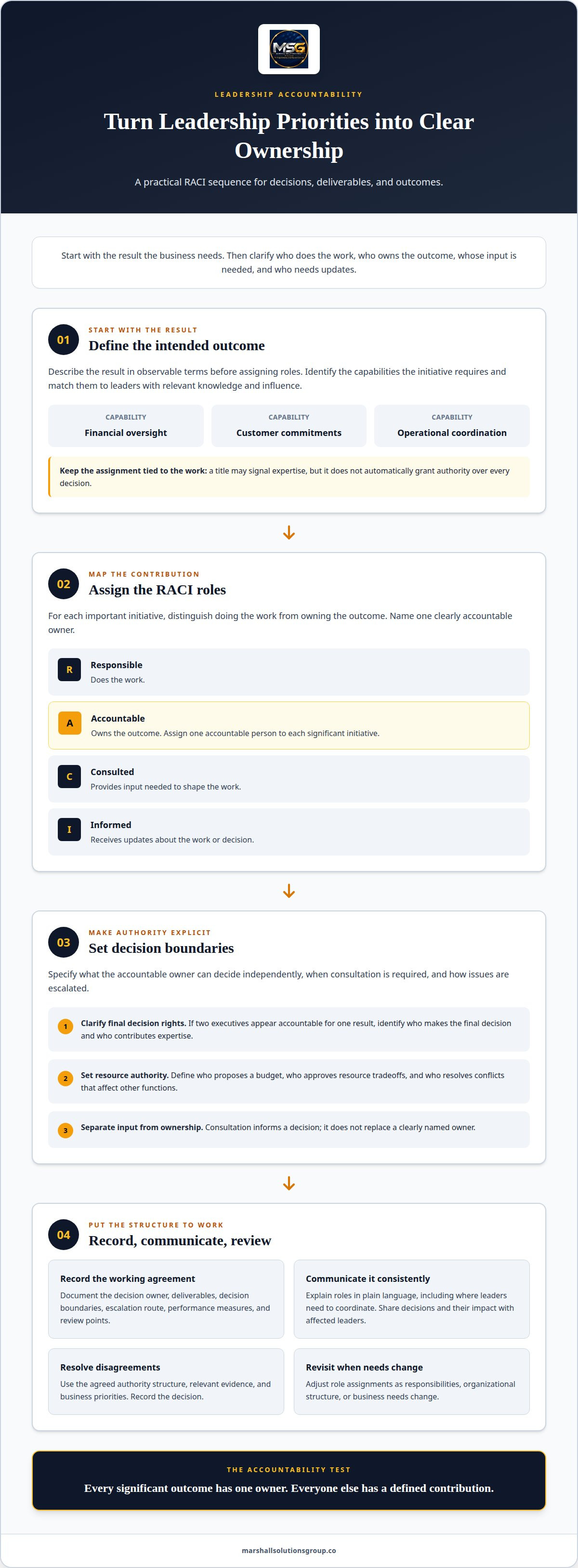
Build a RACI around decisions and deliverables, not job titles alone. For each important initiative, define the intended outcome first, then assign the work and decision rights needed to achieve it.
-
Identify Core Leadership Team Roles
Start with the capabilities the initiative requires, such as financial oversight, customer commitments, or operational coordination. Match each capability to a leader with relevant knowledge and influence. A title may signal expertise, but it does not automatically confer authority over every decision. Define how each leader contributes to the outcome.
-
Set Outcomes, Accountability, and Authority
Describe the result in observable terms, then name one person accountable for achieving it. In a RACI, the responsible person does the work; the accountable person owns the outcome. Identify who must be consulted and who needs updates. State the accountable owner’s decision boundaries and escalation route. If responsibilities overlap, specify who resolves competing recommendations.
-
Assign Strategy, Budgeting, and Performance
Connect strategic priorities to the decisions needed to execute them. Define who proposes the budget, who approves resource tradeoffs, and who monitors performance. For example, a department lead might recommend spending tied to a deliverable, while an executive with broader authority resolves conflicts affecting other functions. Record measures and review points so the team can address gaps before they disrupt delivery.
For major initiatives, a RACI model assigns responsibility to the person doing the work, accountability to the person who owns the outcome, consultation to those whose input is needed, and information-sharing to those who need updates. Each significant initiative should have one clearly accountable owner. Leadership team members should contribute strategic thinking and solutions, not be included solely because of their titles. Use the assignments to clarify whose contribution advances the outcome and whose role is to shape the work or receive updates. This ties participation to the work and distinguishes input from ownership in decision-making.
Marshall Solutions Group
Marshall Solutions Group helps leadership teams turn unclear responsibilities into practical decision-making and accountability structures. When executives agree on priorities but ownership, authority, or follow-through remain unclear, we help clarify how the team works and how decisions move into execution.
Our organizational and operational improvement services connect leadership decisions with the operating practices needed to put them into action. The aim is a workable structure that supports execution, not a chart for its own sake.
Responsibilities and decision rights are defined through the agreed scope of work.
Put Clear Decision Rights Into Practice
Role clarity must hold up in leaders’ everyday decisions. Treat the roles and responsibilities of a leadership team as a working agreement, and revisit it when business priorities or reporting relationships change. This keeps decision rights aligned with current needs.
If your team needs support putting clearer responsibilities into practice, discuss leadership and operational improvement with Marshall Solutions Group. Start by identifying decisions that lack a clear owner and the responsibilities that need to change.
Frequently Asked Questions
What Are the Roles and Responsibilities of a Team Leader?
A team leader turns agreed priorities into coordinated work. They set expectations, connect people whose work depends on one another, monitor progress, and raise obstacles that require a decision. For example, if a deadline depends on two departments, the leader clarifies handoffs and flags delays early. Their job is to keep work moving, not to do every task themselves.
What Is the Main Purpose of a Team Leader?
A team leader helps a group deliver its assigned results while keeping work aligned with wider business priorities. That means translating direction into clear expectations, tracking progress, and addressing problems before they become larger disruptions. The leader also brings unresolved tradeoffs to the right decision-maker rather than letting uncertainty stall the team.
What Is the Role of a Team Leader in Fostering Team Dynamics?
A team leader creates the conditions for people to coordinate and address disagreements constructively. They invite input from those closest to the work, make room for differing views, and keep discussions focused on evidence and shared objectives. If a handoff fails, address the process and expectations directly. Don’t let unresolved friction turn into blame between team members.
What decision-making authority should a leadership team have?
A leadership team should have authority over decisions affecting enterprise priorities, resource tradeoffs, and coordination across functions, within the organization’s governance boundaries. Functional leaders can handle routine decisions in their areas. Set escalation criteria for choices with broader consequences, such as changes affecting another function’s commitments or the organization’s strategic direction.
What are best practices for defining leadership team roles and accountability?
Define the roles and responsibilities of a leadership team by distinguishing ongoing functional duties from temporary initiative work. For each assignment, describe the expected result, decision limits, dependencies, and reporting expectations. Specify how exceptions are escalated so leaders aren’t left guessing. Revisit the agreement when strategy, structure, or a leader’s responsibilities change.
Disclaimer
The information provided in this article is for general informational and educational purposes only and does not constitute legal, financial, accounting, engineering, or other professional advice. Marshall Solutions Group, Inc. makes no representations or warranties regarding the completeness or applicability of this information to any specific situation. Readers should consult appropriately qualified professionals before making decisions requiring specialized professional advice.