Founder Involved in Every Business Decision? Reduce Reliance
By Chelvis “CJ” Marshall, President & Founder
When a founder involved in every business decision slows growth, learn how to transfer routine authority, clarify decision rights, and reduce bottlenecks.

Article by
Chelvis “CJ” Marshall
Chelvis "CJ" Marshall is President and Founder of Marshall Solutions Group (MSG), a veteran-owned management consulting firm helping organizations strengthen leadership, improve operations, and turn strategy into disciplined execution. MSG specializes in Organizational & Operational Improvement, Growth Strategy & Business Development, and Program & Project Management.
A retired U.S. Navy Senior Chief, CJ served as the senior enlisted engineering leader aboard USS McCampbell (DDG-85), overseeing a 137-person engineering department responsible for mission-critical shipboard systems. He subsequently advanced into Fortune 500 enterprise sales and leadership, bringing operational discipline and commercial experience to complex business environments. He is completing his MBA at Syracuse University's Whitman School of Management.
CJ's approach reflects a central principle: strategy creates direction, but leadership, accountability, and disciplined execution determine whether organizations can deliver. His work focuses on helping leadership teams establish the structures, operating practices, and management discipline needed for sustained performance.
When a founder is involved in every business decision, quality may stay high, but the founder can also become the company’s biggest bottleneck. If routine approvals, customer issues, and operating choices all wait for one person, the team slows down and growth depends on the founder’s availability.
This pattern is common in a business’s early stages, but it does not have to become the permanent operating model. Start reducing founder dependence by tracking recurring decisions that reach the founder and transferring one category at a time. This article explains how to identify functions that rely most on the founder, distinguish decisions that should stay at the top from those the team can own, and plan a practical transition. The goal is not to remove the founder from the business. It is to give people clear authority to act without seeking permission for every issue.
Key Takeaways
- Early founders often cover multiple functions, but that arrangement can become a growth constraint as the company adds people and complexity.
- Track which decisions reach the founder to identify where authority, context, or clear ownership is missing.
- Transfer recurring decision categories gradually, while keeping unusually consequential or difficult-to-reverse decisions at the leadership level.
- Begin reducing reliance within weeks by clarifying decision rights and giving team members defined authority to act.
Table of Contents
Can a Business Scale If Every Decision Still Needs the Founder?
Yes, a business can scale, but decision authority must grow alongside responsibilities. In the early stages, founders often handle finance, sales, hiring, and operations.
Founder and CEO Responsibilities
Founders establish the company, set its direction, and secure resources. Early on, they may also handle finance, sales, hiring, and operations. A co-founder may share ownership while leading a function, such as product. A CEO puts strategy into practice, manages employees, and coordinates execution. Clear responsibilities and authority matter more than titles.
Versus Founder-Dependent Businesses
Businesses rely on the founder for direction while employees own defined decisions. In founder-dependent businesses, routine choices return to the founder even when another team member has the necessary context. The distinction matters: a founder can lead without being a required approval step. For example, a sales lead can approve standard proposals and escalate unusual commitments.
Why Founders Retain Decision Control
Founders may retain control because early decisions involved ownership, financial risk, and responsibility for survival. If they built the offer, won customers, and hired the first employees, delegation can feel risky. That concern grows when expectations are undocumented and authority is unclear. Define limits and escalation triggers, then review outcomes instead of reclaiming a decision after one imperfect call.
Assessing Critical Functions That Rely on the Founder
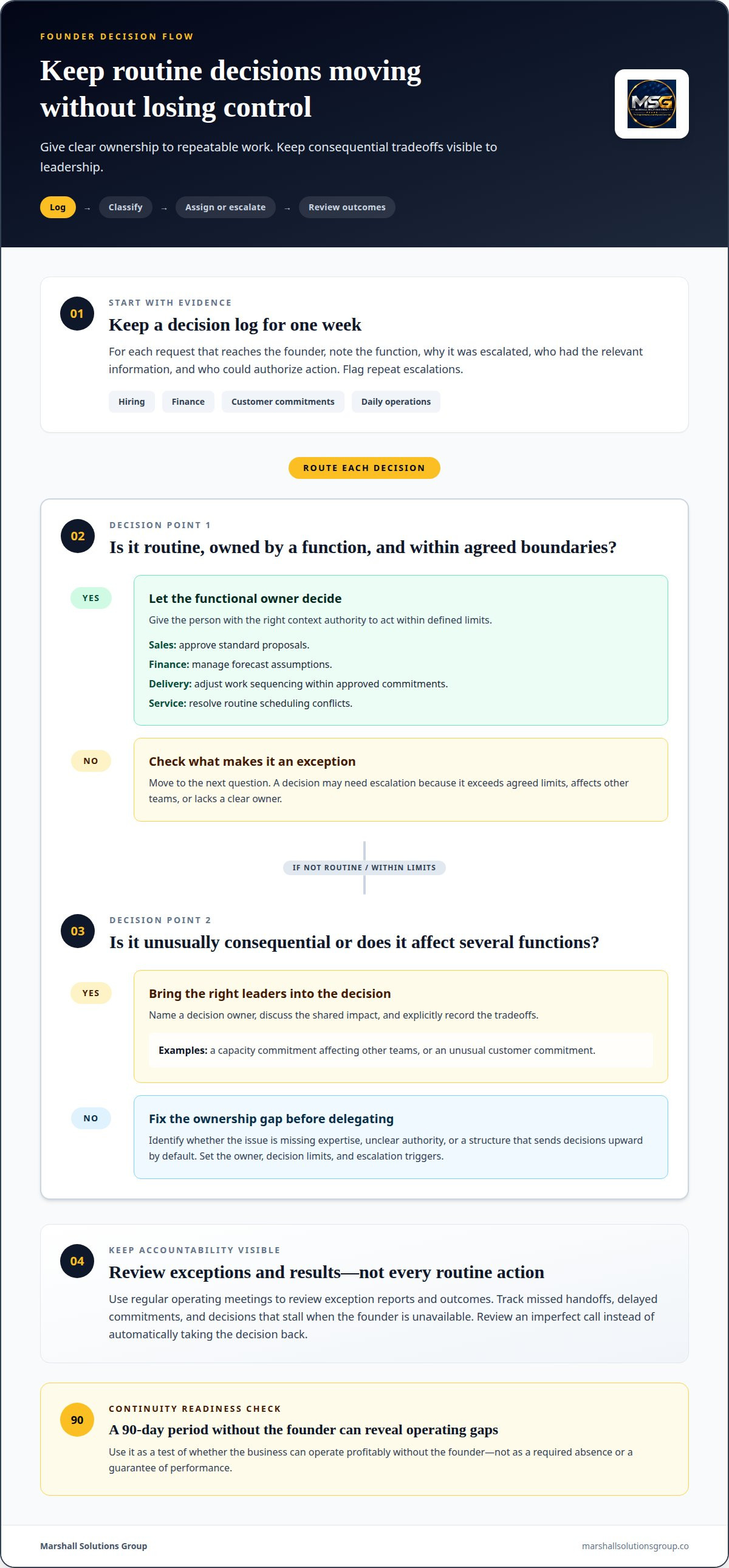
Start with a decision log for a week. Record each request that reaches the founder, the function it concerns, and why it was escalated. The pattern can show whether the issue is missing expertise, unclear authority, or an operating structure that sends decisions upward by default.
Mapping Founder-Dependent Functions
Map decisions to the functions they affect. Log issues involving hiring, finance, customer commitments, and daily operations, then note who had relevant information and who could authorize action. Classify the founder under executive leadership or general management, unless the founder also holds a specific operating role, such as CTO. This helps reveal whether dependence is concentrated in one area or spread across the business. Flag repeat escalations separately.
Decision Authority by Functional Expertise
Let functional expertise guide decisions within agreed boundaries. For example, a finance lead can manage forecast assumptions, while a delivery lead adjusts work sequencing within approved commitments. Decisions that affect several functions call for a shared discussion, a clear decision owner, and an explicit record of tradeoffs. This supports autonomy without treating each function as separate from the others.
Delegating Decisions Without Losing Control
Give managers and employees authority over defined decisions, with clear triggers for escalating exceptions. A service manager might resolve routine scheduling conflicts, while capacity commitments that affect other teams go to leadership. The founder can step back from daily approvals by reviewing exception reports and outcomes at regular operating meetings. This preserves visibility and accountability without requiring advance approval for every action.
Founder Involvement as a Business Bottleneck
Founder approval can protect quality in a startup, but it can also limit throughput. When routine exceptions, customer adjustments, and staffing choices wait for one person, the founder’s calendar sets the pace of work. A founder involved in every business decision can constrain multiple functions, leaving managers accountable for delivery without enough room to respond.
The impact depends on the decision. A delayed pricing exception may hold up a customer commitment; a delayed staffing choice may leave a project short of capacity. Small waits like these can add up across operations. The founder’s judgment remains valuable for setting direction and handling high-consequence tradeoffs, but routine approvals pull attention from strategy and other executive responsibilities.
Founder dependence also creates continuity risk. If customer knowledge, approval logic, and key relationships sit with one person, employees may struggle to maintain service during that person’s absence. A 90-day period without the founder can test whether the business can operate profitably without them. Treat it as a readiness test that exposes gaps, not as a required absence or a guarantee of performance.
Shift the founder’s focus from approving activity to setting direction and reviewing results. Track missed handoffs, delayed commitments, and decisions that stall when the founder is unavailable. These signals show whether the organization can maintain its strategy while routine work moves forward. The aim is not less leadership, but leadership focused where the founder’s judgment matters most.
How Marshall Solutions Group Can Help
At Marshall Solutions Group, we help companies align leadership responsibilities with operating decisions. When approvals, escalation routes, and reporting all run through one person, growth can stall even when employees are capable.
Our Operating Assessment can examine how decisions move across functions. It can identify repeated approvals, unclear ownership, gaps in management routines, and decisions that should remain with the founder. These findings give leaders a basis for setting authority, escalation criteria, and accountability, rather than delegating broadly and hoping everyone interprets boundaries the same way.
We can help turn findings into working roles, decision paths, and management routines through Organizational & Operational Improvement. If shifting authority changes how leaders and employees coordinate, Organizational Leadership & Change can support the transition. Depending on the agreed scope, we can also support implementation and address execution barriers. Track progress through decision turnaround, unresolved escalations, and whether teams follow agreed authority without avoidable reversals. The engagement scope defines responsibilities, deliverables, and authority.
An assessment can provide a structured starting point, but it isn’t required for every engagement. If you want to examine where founder reliance is constraining execution, consider the operational assessment.
Build a Business That Can Move Without Waiting
Reducing founder dependence does not mean stepping away from leadership. It means building an organization where sound decisions happen at the right level, allowing the founder to focus on direction, priorities, and growth. When a founder is involved in every business decision, make decision ownership explicit and support it with routines the team can sustain.
Marshall Solutions Group can help clarify that work through an operational assessment, Strategy & Operations Consulting, or Organizational Leadership & Change. The right support depends on the challenge and the agreed scope; an assessment is an option, not a required first step. Start a conversation about your organization’s needs through Marshall Solutions Group’s contact page. Clearer ownership can give your team room to act and your business room to grow.
Frequently Asked Questions
How quickly can founder dependency be reduced?
Start reducing founder dependence by transferring one recurring decision category at a time. Choose a contained area, such as routine customer resolutions, and track whether decisions are handled without returning for approval. The pace depends on whether the new decision-maker has enough context, authority, and support to own the outcome.
What are the signs of founder bottleneck or founder dependency?
Look for work that waits on the founder even though the responsible employee has the information needed to proceed. Other signs include staff copying the founder on routine messages, decisions being reversed without clear criteria, and customers getting different answers depending on the founder’s availability. These patterns point to unclear decision rights or knowledge held by one person.
How does founder involvement in every decision affect business growth and employees?
Founder dependence can limit how much work the business handles because decisions accumulate with one person. Employees may stop offering ideas or taking ownership if their judgment is routinely overridden. For example, a capable team lead who needs approval for routine schedule changes has less time to manage delivery and solve problems within the team.
What are the risks of a business depending on its founder for every decision?
Dependence creates continuity risk when the founder is unavailable and can obscure whether other leaders can run their functions independently. Customer responses may slow, internal priorities may stall, and important knowledge may remain undocumented. It can also make it harder to distinguish decisions that genuinely need executive judgment from those delayed by habit.
How can a founder delegate decision-making effectively?
Give a team member a defined decision area, the information needed to act, and clear conditions for escalation. For example, authorize a service manager to resolve ordinary delivery issues while routing unusual commitments to leadership. Review the reasoning and outcome together afterward. Use that discussion to refine the boundaries, not automatically take authority back.
Disclaimer
The information provided in this article is for general informational and educational purposes only and does not constitute legal, financial, accounting, engineering, or other professional advice. Marshall Solutions Group, Inc. makes no representations or warranties regarding the completeness or applicability of this information to any specific situation. Readers should consult appropriately qualified professionals before making decisions requiring specialized professional advice.