Fractional COO vs EOS Implementer: Roles and Business Fit
By Chelvis “CJ” Marshall, President & Founder
Learn whether a fractional COO vs EOS Implementer fits your need for EOS guidance, ongoing operational leadership, or both, with clear role ownership.

Article by
Chelvis “CJ” Marshall
Chelvis "CJ" Marshall is President and Founder of Marshall Solutions Group (MSG), a veteran-owned management consulting firm helping organizations strengthen leadership, improve operations, and turn strategy into disciplined execution. MSG specializes in Organizational & Operational Improvement, Growth Strategy & Business Development, and Program & Project Management.
A retired U.S. Navy Senior Chief, CJ served as the senior enlisted engineering leader aboard USS McCampbell (DDG-85), overseeing a 137-person engineering department responsible for mission-critical shipboard systems. He subsequently advanced into Fortune 500 enterprise sales and leadership, bringing operational discipline and commercial experience to complex business environments. He is completing his MBA at Syracuse University's Whitman School of Management.
CJ's approach reflects a central principle: strategy creates direction, but leadership, accountability, and disciplined execution determine whether organizations can deliver. His work focuses on helping leadership teams establish the structures, operating practices, and management discipline needed for sustained performance.
The fractional COO vs. EOS Implementer decision depends on the work your business needs. An EOS Implementer guides the leadership team in adopting the Entrepreneurial Operating System and its tools. A fractional COO provides ongoing operational leadership, helping manage broader responsibilities and turn priorities into action.
Both roles can strengthen accountability, but they aren’t interchangeable. If your main need is to install and learn EOS, an Implementer may fit. If the business needs an experienced leader to manage operational work beyond a single framework, a fractional COO may be a better match.
This article explains how the roles differ, when they can work together, and how to choose an operating model for your company’s stage. It also covers what to consider when deciding whether you need a system, ongoing leadership, or both.
Key Takeaways
- Choose an EOS Implementer when your leadership team needs help learning and applying EOS tools.
- Choose a fractional COO when the business needs ongoing operational leadership beyond adopting a framework.
- Define who owns decisions, execution, and accountability before combining the two roles.
- Match the operating model to your company’s current management capacity and the work that needs to get done.
Table of Contents
How exactly does a Fractional COO / Integrator work?
The distinction is ownership: an Integrator drives internal execution, while an EOS Implementer teaches the operating system. A full-time COO takes on ongoing operational responsibility within the company.
Fractional Integrator Responsibilities
A Fractional Integrator turns leadership priorities into operational work, then tracks owners, deadlines, and progress. The role may include running weekly leadership routines, resolving cross-team issues, and keeping strategic priorities visible. Unlike an EOS Implementer, this role owns execution rather than simply facilitating the framework. A fractional COO may also cover broader functions, such as finance, HR, product, or vendor management.
EOS Implementer Responsibilities
An EOS Implementer guides the leadership team through EOS adoption by teaching its tools and facilitating structured sessions. The Implementer helps the team set priorities, process issues, and establish accountability within the framework. Unlike an Integrator, the Implementer does not become the company’s internal execution leader. After initial sessions, support may continue at roughly one full day per quarter.
When assessing qualifications, look for an Integrator with relevant operational leadership experience and a record of owning execution. An EOS Implementer should demonstrate skill in facilitating EOS sessions and teaching its tools.
The main risk is blurred ownership: an Integrator who is expected to facilitate and troubleshoot may struggle to do both well. Define decision rights, deliverables, and accountability before the engagement begins.
| Option | Primary responsibility | Operating cadence |
|---|---|---|
| Fractional Integrator or COO | Operational execution; broader COO scope may include multiple functions | Part-time, often one to three days a week |
| EOS Implementer | Facilitate EOS adoption and teach its tools | Sessions, then roughly one full day per quarter |
| Full-time COO | Embedded, ongoing responsibility for operations and execution | Continuous internal leadership |
Choose based on whether the gap is framework adoption, execution ownership, or sustained internal leadership.
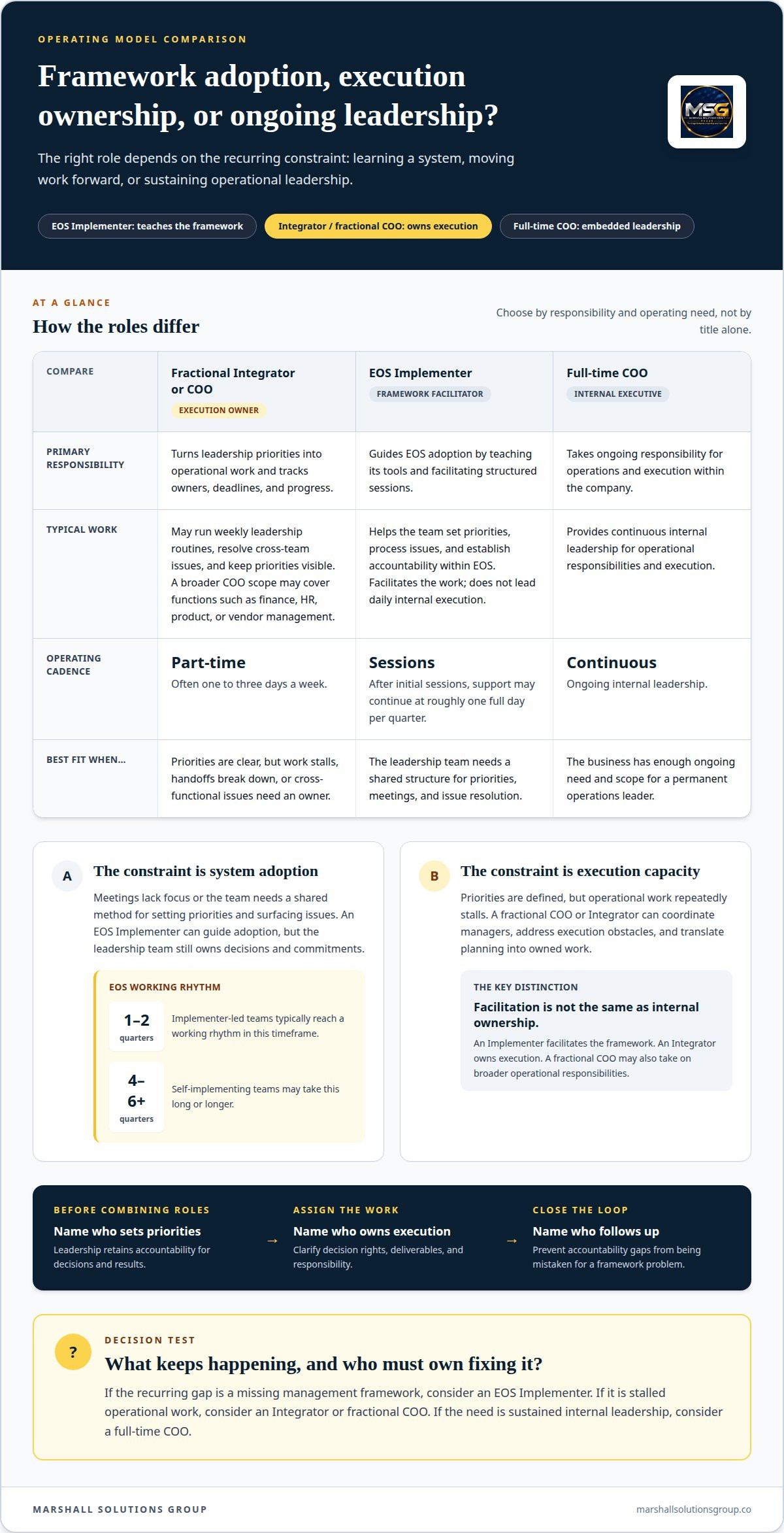
EOS Implementer vs fractional COO: which does a business need?
For a company, the decision turns on whether the leadership team needs a management framework or ongoing operational ownership. EOS adoption doesn’t transfer company direction to an Implementer: the leadership team remains accountable for decisions and results.
Role Definitions
An EOS Implementer guides the leadership team through EOS tools, planning sessions, and issue processing. The framework gives the team structure for priorities and accountability, but leaders still define strategy. Quarterly sessions help review commitments and surface problems. The Implementer facilitates that work rather than taking charge of daily execution.
A fractional COO provides active leadership for operational decisions and follow-through. Unlike an Implementer, this executive can take responsibility for coordinating across functions, resolving execution obstacles, and translating annual planning into owned work. The role can use EOS or other management methods; it isn’t limited to one operating system.
Choosing Based on Company Needs
Start with the recurring problem. If the founder and leadership team lack a shared structure for priorities, meetings, and issue resolution, an EOS Implementer can guide adoption. The leadership team must still own decisions and complete its commitments between sessions, including the thirteen weeks between quarterly reviews.
If priorities are clear but operational work stalls, a fractional COO may be a closer fit. For example, a founder may need someone to coordinate managers, address cross-functional delays, and keep execution moving. That need differs from learning EOS tools. A company can also use both roles, provided the Implementer facilitates the framework while the COO owns internal operating results.
Define decision rights before either engagement begins: name who sets priorities, who owns execution, and who follows up. This prevents accountability gaps from being mistaken for a meeting or framework problem.
Choosing an operating model for a business's stage
Choose based on the constraint slowing growth, not the company’s headcount or the founder’s title. An EOS framework can add structure when leadership meetings lack focus; operational leadership is needed when decisions repeatedly stall after those meetings.
Early in growth, owners may still make most important decisions. If the leadership team needs a shared vision, regular meetings, and a method for surfacing issues, an EOS Implementer facilitates adoption. Implementer-led teams typically reach a working rhythm in 1-2 quarters. Leaders still need to attend sessions, own commitments, and keep the business running during the change.
Self-implementing EOS teams often take 4-6 quarters or longer to reach a working rhythm. That difference matters when leaders are stretched: the framework requires time, attention, and internal ownership. An external facilitator can help establish the routine, but cannot replace leadership’s follow-through. Use the fractional COO vs EOS Implementer comparison to identify whether your constraint is system adoption or execution capacity.
As complexity grows, determine whether the main gap is the operating system or the ability to execute. If priorities are clear but department handoffs, decisions, or unresolved issues disrupt delivery, an Integrator or fractional COO can provide ongoing operational leadership. A company with sufficient need and scope for a permanent executive role may instead need a full-time operations leader.
Make the fractional COO vs EOS Implementer decision by defining the recurring problem, naming who must own its resolution, and matching support to that responsibility. A focused operational assessment can help clarify where ownership or management routines need attention. Combining facilitator and execution-owner duties without clear boundaries can split attention between running sessions and addressing operational problems.
Marshall Solutions Group
Marshall Solutions Group helps leaders clarify whether their operating gap lies in leadership, organizational structure, or execution. An operational assessment can help identify the responsibilities and decisions the business needs to strengthen.
For organizations ready to act, Strategy & Operations Consulting can support planning and implementation within an agreed scope. The right starting point depends on the specific work, authority, and ownership the organization needs, not simply the title attached to a role.
This approach keeps the focus on the business need: defining what must change, who will own the work, and how support fits the organization’s capacity.
Make the Next Operating Decision Deliberate
The fractional COO vs. EOS Implementer decision should start with the work your leadership team cannot consistently own today. Name the gap, identify who has the authority to address it, and agree on what progress will look like. That gives you a practical basis for selecting support, rather than choosing a title first and trying to fit the business around it.
Then make the decision clear to the people affected. Explain who sets priorities, who follows through, and where unresolved issues go. Clear expectations help the team understand how the operating model supports its work and where accountability remains internal.
Sound operating decisions don’t remove leadership’s responsibility. They make ownership easier to see and act on. With that clarity, your next move can be deliberate and grounded in the needs of the business.
Frequently Asked Questions
What Is a Fractional COO?
A fractional COO provides part-time operational leadership under agreed responsibilities and decision rights. For example, a growing company might assign this leader to coordinate department heads, improve operating routines, and keep cross-functional work moving. The role’s authority should be explicit: leaders need to know which decisions the COO owns, which require founder approval, and how progress is reported.
Are These Roles Mutually Exclusive?
No. A company can engage an EOS Implementer to facilitate adoption while a separate operations leader owns internal execution. The arrangement works best when responsibilities don’t overlap: the Implementer runs framework sessions, while the internal leader translates decisions into work and follows through. If one person holds both roles, establish clear boundaries so facilitation duties don’t displace operational priorities.
How are a Fractional Partner and EOS Implementer similar?
Both can help leadership teams clarify priorities and address organizational problems. The difference lies in their scope and method: an EOS Implementer teaches and facilitates EOS, while a fractional partner can provide broader strategic, financial, and operational guidance. For example, a leadership team may use EOS meetings to surface an issue, then rely on a partner for decision support beyond the framework.
How much does retaining a Fractional COO / Integrator cost?
There isn’t one standard fee that applies to every engagement. The scope depends on the responsibilities assigned, the leader’s availability, their decision rights, and the operational work requiring attention. A limited execution role differs from broader responsibility across several functions. Define those expectations first: they shape the work and commitment being priced.
Need Help Choosing the Right Operational Leadership Model?
Start by identifying what remains unresolved: unclear priorities, inconsistent follow-through, or a lack of operational decision ownership. Marshall Solutions Group can help leaders examine responsibilities, decision rights, and operating needs through an operational assessment or Strategy & Operations Consulting. Contact our team to discuss your current challenge and the decisions you need to make next.
Disclaimer
The information provided in this article is for general informational and educational purposes only and does not constitute legal, financial, accounting, engineering, or other professional advice. Marshall Solutions Group, Inc. makes no representations or warranties regarding the completeness or applicability of this information to any specific situation. Readers should consult appropriately qualified professionals before making decisions requiring specialized professional advice.