Capacity Planning for a Consulting Firm: A Practical Reference
By Chelvis “CJ” Marshall, President & Founder
Capacity planning for a consulting firm compares demand with available time by role and skill. Learn to spot staffing gaps and manage pipeline risk early.

Article by
Chelvis “CJ” Marshall
Chelvis "CJ" Marshall is President and Founder of Marshall Solutions Group (MSG), a veteran-owned management consulting firm helping organizations strengthen leadership, improve operations, and turn strategy into disciplined execution. MSG specializes in Organizational & Operational Improvement, Growth Strategy & Business Development, and Program & Project Management.
A retired U.S. Navy Senior Chief, CJ served as the senior enlisted engineering leader aboard USS McCampbell (DDG-85), overseeing a 137-person engineering department responsible for mission-critical shipboard systems. He subsequently advanced into Fortune 500 enterprise sales and leadership, bringing operational discipline and commercial experience to complex business environments. He is completing his MBA at Syracuse University's Whitman School of Management.
CJ's approach reflects a central principle: strategy creates direction, but leadership, accountability, and disciplined execution determine whether organizations can deliver. His work focuses on helping leadership teams establish the structures, operating practices, and management discipline needed for sustained performance.
Adding people isn’t the same as adding usable capacity. Capacity planning for a consulting firm must account for the roles and skills required, work already committed, and time spent on responsibilities beyond client delivery. A firm-wide headcount can look healthy while a shortage of experienced project leaders puts delivery at risk.
Pipeline work adds another complication. Planning around uncertain opportunities too early can leave capacity unused; waiting until work is signed can leave too few people in the right roles. We’ll show how to compare demand with realistic availability, account for internal responsibilities and fragmented assignments, and identify constraints early. The goal is a practical planning routine that supports responsible staffing and delivery decisions without adding unnecessary bureaucracy.
Key Takeaways
- Separate capacity planning from scheduling: test whether the work fits before assigning it to specific people.
- For capacity planning for a consulting firm, compare available time with demand by role, skill, and period, not just total headcount.
- Distinguish contracted work from probable and exploratory pipeline, and record assumptions so forecasts don’t become accidental commitments.
- Review capacity gaps regularly and assign an owner to decisions about timing, scope, staffing mix, or pursuit priorities.
Table of Contents
Capacity Planning for a Consulting Firm Starts with Real Delivery Capacity
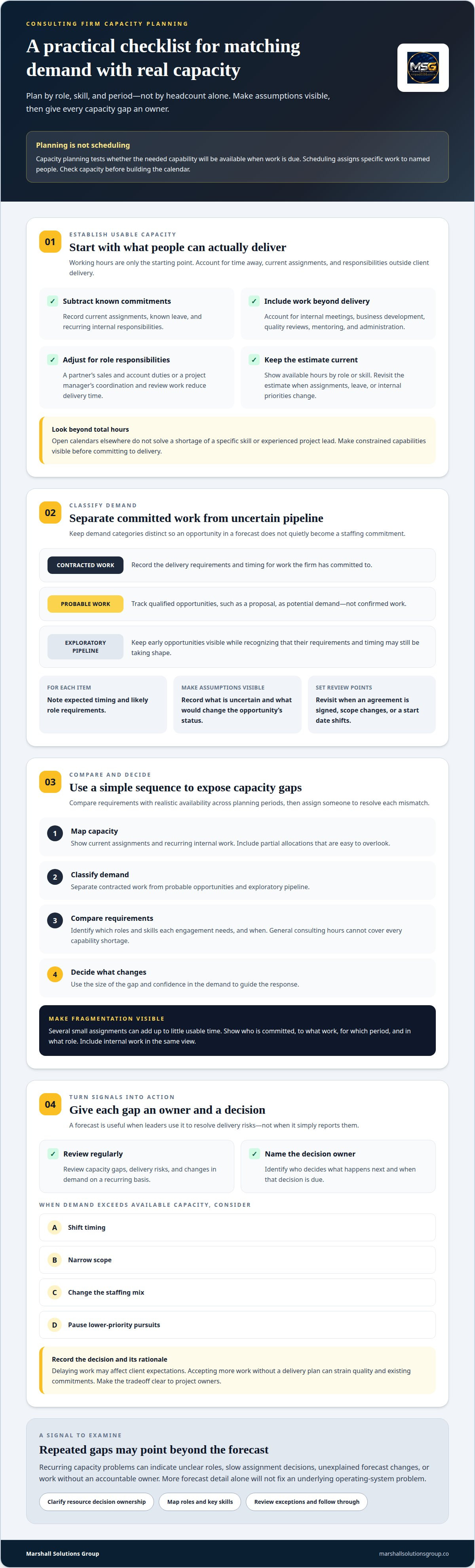
Capacity planning for a consulting firm compares the delivery work a team can realistically perform with the work clients require across roles, skills, and time periods. It is not a headcount exercise. A firm may have several consultants available overall and still lack the specialist or experienced project lead a particular engagement needs.
Planning and scheduling address different questions. Capacity planning tests whether the required capability will be available when the work is due. Scheduling assigns specific work to named people. Building a project schedule before checking capacity can create a polished calendar that depends on unavailable skills or leaves no room for existing commitments.
The distinction between nominal and effective capacity is central to the core principles of capacity planning. A person’s working hours are not all available for client delivery. Leave, internal meetings, business development, quality reviews, mentoring, and administrative responsibilities all use time.
What counts as available capacity in a consulting firm?
Start with each person’s working time for the planning period. Subtract known leave and recurring commitments, then account for responsibilities that vary by role. A partner’s delivery capacity, for example, may be reduced by sales and account leadership duties. A project manager may need time for coordination and review that doesn’t appear as direct client work.
Make the assumptions visible. Record each person’s current commitments, known time away, internal responsibilities, and available hours by role or skill. Note what remains uncertain and which capabilities are already constrained. Revisit the estimate when assignments, leave, or internal priorities change. Treating an old availability figure as fixed can hide a developing bottleneck.
Look at capacity by capability, not just by total hours. If several engagements require the same scarce skill during the same period, open calendars elsewhere won’t close the gap. Leaders need to see that mismatch before making delivery commitments.
How to Match Consulting Demand with Capacity Without False Precision
A useful forecast separates what is known from what remains uncertain. For capacity planning for a consulting firm, use a simple sequence: map available capacity by role and skill, classify demand, compare the two across planning periods, then assign someone to resolve each gap.
- Map capacity. Record current assignments and recurring internal responsibilities, including small allocations that are easy to overlook.
- Classify demand. Separate contracted work from probable opportunities and early exploratory pipeline.
- Compare requirements. Identify which roles and skills each engagement needs, and when. A surplus of general consulting hours won’t cover a shortage of a specific capability.
- Decide. Adjust timing, scope, staffing mix, or pursuit priorities based on the size of the gap and confidence in the demand.
Track work in a way that makes fragmented assignments visible. Someone assigned to several projects may look available in each project’s plan, while the combined commitments leave little usable time. Include internal work in the same view, and show partial allocations rather than rounding them away. A simple capacity record should make clear who is committed, to what work, for which period, and in what role.
How should a firm plan for uncertain pipeline work?
Keep contracted demand distinct from probable work, such as a qualified proposal, and exploratory opportunities that are still taking shape. For each item, record the assumptions that affect staffing: expected timing, likely role requirements, and what would change its status. Don’t turn an opportunity into a staffing commitment simply because it appears in the forecast.
Build scenarios instead of presenting one uncertain projection as fact. Set review points tied to meaningful changes, such as a signed agreement, revised scope, or shifted start date. This reflects the difference between longer-range decisions and near-term resource assignments described in IBM’s operational vs. strategic capacity planning framework. The goal isn’t perfect prediction. It’s a visible set of assumptions and a clear decision owner.
Turn Capacity Signals into Accountable Consulting-Firm Decisions
A capacity forecast matters only if leaders use it to make decisions. Review capacity gaps, delivery risks, and changes in demand on a recurring basis. For each issue, name the person responsible for deciding what happens next and when the decision is due. A forecast without an owner is a report, not a management tool.
When demand exceeds a role’s available capacity, utilization alone won’t resolve the conflict. Leaders may need to shift timing, narrow scope, change the staffing mix, or pause lower-priority pursuits. Each option has a cost: delaying work may affect client expectations, while accepting more work without a delivery plan can strain quality and existing commitments. Record the decision and its rationale so project owners know what to do.
When does a capacity problem point to an operating-system problem?
One tight period may be temporary. Repeated gaps, however, can point to unclear roles, decision rights that slow assignments, forecasts that change without explanation, or work without an accountable owner. In those cases, adding detail to the forecast won’t address the underlying cause.
Role mapping can clarify who owns resource decisions and where key skills sit. Scorecards can track whether planned capacity aligns with actual assignments, while a regular operating cadence gives leaders a place to review exceptions and follow through. Use these methods where they fit the work and agreed scope. Organizational & Operational Improvement can address capacity issues rooted in broader role or management-system problems. Responsibilities and decision authority are defined by the agreed engagement scope.
Keep each review focused: identify the constraint, assign an owner, choose a response, and set a point to revisit the decision. That turns capacity planning for a consulting firm into a working management routine, not another forecast that sits untouched.
Make Capacity Planning Part of How You Lead
Capacity planning for a consulting firm should inform which commitments leadership accepts and how the firm protects delivery quality as priorities shift. Make those choices part of normal management, with a clear owner for each decision and follow-through on what was agreed.
When recurring constraints point to broader operating issues, learn more about Organizational & Operational Improvement. A named senior leader owns each engagement from start to finish, with responsibilities and authority defined by the agreed scope.
Start with one decision your current planning process leaves unresolved. Make ownership and the next action clear, then revisit whether the decision addressed the constraint. A realistic view of what the organization can take on gives leaders a sound basis for action.
Frequently Asked Questions
What is capacity planning for a consulting firm?
It’s a management view of whether delivery capability can support the firm’s workload over a defined period. Make the view useful by stating its time horizon, data owner, and assumptions about availability. For example, specify whether the estimate includes internal responsibilities or only client assignments. Clear boundaries help leaders interpret the plan consistently and know when to update it.
How is capacity planning different from resource scheduling?
Scheduling turns an agreed delivery plan into named assignments and dates; capacity planning tests the assumptions behind that plan. Use scheduling changes as evidence: repeated reassignments, uncovered tasks, or conflicts between projects may indicate that the forecast needs revision. A schedule shows who is expected to work, but leaders still need to check whether those assignments are feasible together.
How should consulting firms account for pipeline work in capacity plans?
For each opportunity, record the assumptions that could change its staffing implications, such as a shifted start date, expanded scope, or delayed decision. Set a review trigger, such as a proposal moving to a new sales stage or a client confirming timing. This keeps tentative demand visible without allowing it to displace commitments prematurely.
Which capacity metrics should a consulting firm monitor?
Choose measures that inform a decision, then define how each is calculated and who reviews it. Available capacity and demand by skill can highlight emerging pressure; planned versus actual allocation can show where estimates diverge. Interpret changes before acting. A variance may reflect revised scope, delayed work, or an internal commitment, and each cause calls for a different response.
Disclaimer
The information provided in this article is for general informational and educational purposes only and does not constitute legal, financial, accounting, engineering, or other professional advice. Marshall Solutions Group, Inc. makes no representations or warranties regarding the completeness or applicability of this information to any specific situation. Readers should consult appropriately qualified professionals before making decisions requiring specialized professional advice.