How to Define Goals, Roles, and Benefits in a Process Improvement Plan
By Chelvis “CJ” Marshall, President & Founder
A process improvement plan links workflow problems to business outcomes, selects useful measures, and assigns ownership for testing and sustaining change.

Article by
Chelvis “CJ” Marshall
Chelvis "CJ" Marshall is President and Founder of Marshall Solutions Group (MSG), a veteran-owned management consulting firm helping organizations strengthen leadership, improve operations, and turn strategy into disciplined execution. MSG specializes in Organizational & Operational Improvement, Growth Strategy & Business Development, and Program & Project Management.
A retired U.S. Navy Senior Chief, CJ served as the senior enlisted engineering leader aboard USS McCampbell (DDG-85), overseeing a 137-person engineering department responsible for mission-critical shipboard systems. He subsequently advanced into Fortune 500 enterprise sales and leadership, bringing operational discipline and commercial experience to complex business environments. He is completing his MBA at Syracuse University's Whitman School of Management.
CJ's approach reflects a central principle: strategy creates direction, but leadership, accountability, and disciplined execution determine whether organizations can deliver. His work focuses on helping leadership teams establish the structures, operating practices, and management discipline needed for sustained performance.
Improvement work can look busy without showing whether performance is changing. A process improvement plan should link the problem to meaningful measures, so leaders can judge whether a change is helping the organization meet its objectives.
Choosing measures means more than tracking whatever data is readily available. This article explains how to select useful measures, connect them to business priorities, and use them to guide decisions. It also shows how clear ownership keeps measurement and follow-through on track.
Key Takeaways
- Define the operational problem and connect the improvement goal to a measurable business outcome.
- Document how the revised work method will be tested, evaluated, and made part of routine operations.
- Assign clear ownership for leadership support, project coordination, and the work affected by the change.
- Choose improvements that address real workflow friction and can be sustained by the people responsible for the process.
Table of Contents
What Is a Process Improvement Plan?
A process improvement plan explains how a team will address a workflow problem, put a new method into practice, and measure results. It typically identifies the problem, objective, responsibilities, measures, timeline, communication approach, and follow-up.
-
Choose a Process Improvement Methodology for Your Organization
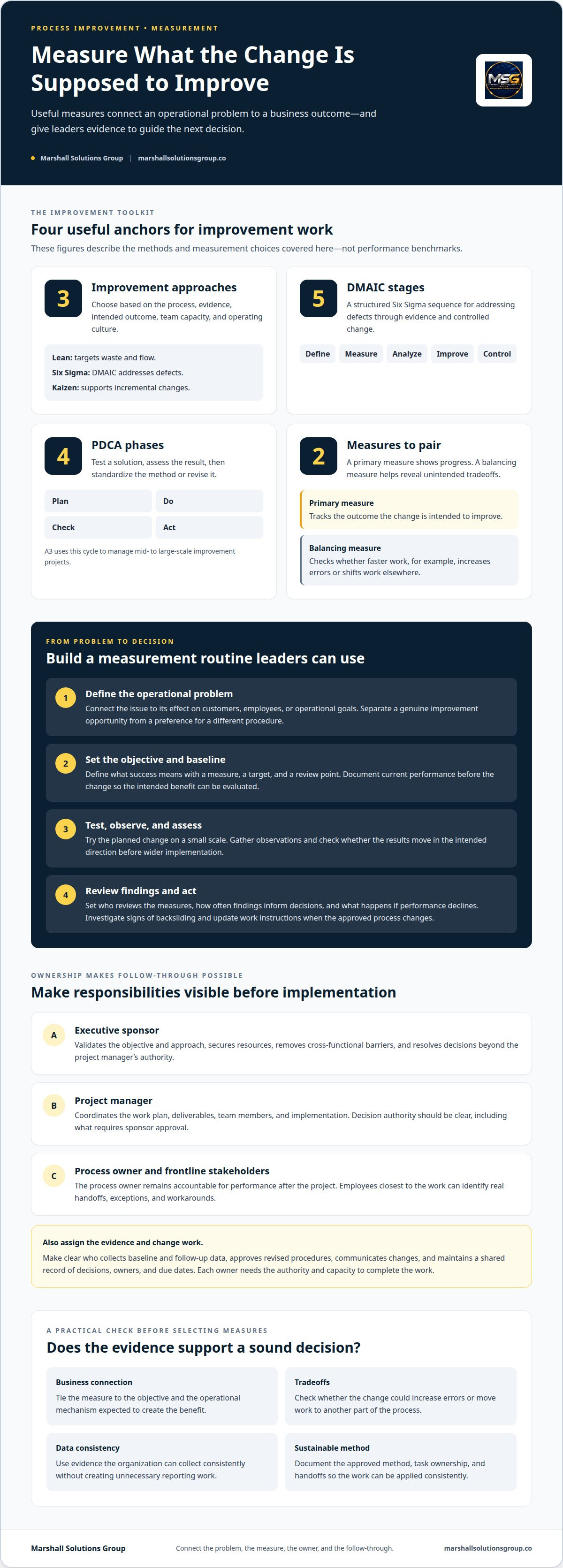
Choose a method based on the process, available evidence, and intended outcome. Lean targets waste and flow; Six Sigma’s DMAIC addresses defects through Define, Measure, Analyze, Improve, and Control; Kaizen supports incremental changes. Consider team capacity and operating culture instead of applying a framework by default.
-
Combine Improvement Methodologies to Fit Your Organization
Professionals combine tools when each serves a defined purpose. For example, process maps can expose delays, while the 5 Whys can help investigate causes. A project template records the objective, owners, timeline, risks, resources, and review points. Cost and savings estimates consider implementation and maintenance demands alongside expected benefits, supporting a reasoned ROI evaluation.
-
Apply and Document a New Work Method
Test a planned change on a small scale, gather observations, and assess results before wider implementation. Involve employees who perform the work, explain the reason for the change, and address concerns through communication, training, and support. Clear work instructions document the approved method, task ownership, and handoffs so teams can apply it consistently.
-
Explore PDCA and A3 Approaches
PDCA moves through Plan, Do, Check, and Act: identify the problem, test a solution, evaluate results, then standardize or revise the method. A3 uses this cycle to manage mid- to large-scale improvement projects. Professionals monitor selected metrics through regular reviews, investigate signs of backsliding, and update work instructions when the approved process changes.
Process improvement definition and benefits
Process improvement changes how work is performed to strengthen outcomes such as service quality, efficiency, or capacity. A professional connects the proposed change to business priorities, then selects evidence that can show whether performance is moving in the intended direction.
- Clarify the business impact. Examine where the issue affects customers, employees, or operational goals. For example, recurring approval delays may affect service commitments even when the underlying work is accurate. Defining the impact helps distinguish a genuine improvement opportunity from a preference for a different procedure.
- Establish what success means. Translate the desired outcome into an objective with a defined measure, target, and review point. If leaders want more predictable delivery, the measure should capture timeliness rather than simply count completed tasks. A useful objective gives everyone involved a shared basis for decisions.
- Choose measures that reveal tradeoffs. Consider whether speeding up a process could increase errors or shift work elsewhere. Pairing a primary measure with a balancing measure helps uncover those effects. Also assess whether the organization can collect consistent data without creating unnecessary reporting work.
- Connect the baseline to business value. Before implementing a change, document current performance and identify how the intended benefit will be assessed. Tie expected savings or capacity gains to a clear operational mechanism rather than assuming they will follow from a target alone. This makes later evaluation more credible.
- Set a monitoring routine. Define who reviews the measures, how often findings inform decisions, and what action follows a decline. When leaders need help aligning performance measures with operational priorities, process improvement support can connect measurement with implementation.
Process improvement project roles and responsibilities
Common risks include unclear ownership, measures that reward one department while harming the broader process, and changes that overlook employee feedback. Assign decision rights before implementation, then review both process measures and stakeholder concerns.
- Name an executive sponsor. The sponsor validates the project objective and approach, secures resources, and removes cross-functional barriers. The sponsor also resolves decisions the project manager cannot settle, such as competing departmental priorities. Without active leadership support, teams may lose access to needed people or face delayed decisions.
- Give one project manager coordination authority. The project manager develops the work plan, tracks deliverables, coordinates team members, and manages implementation. Define which decisions this role can make and which require sponsor approval. When coordination is shared without a clear owner, deadlines and follow-up can be neglected.
- Include process owners and frontline stakeholders. The process owner explains how the business process works and remains accountable for its performance after the project. Employees closest to the work can identify actual handoffs, exceptions, and workarounds. A diagram created without their input may show the intended process, not the work being done.
- Assign responsibility for evidence and change. Identify who collects baseline and follow-up data, approves revised procedures, and communicates changes to affected teams. Make each assignment visible in the project plan. Each owner needs the authority and capacity to complete the assigned work.
- Set a review and escalation routine. Schedule regular reviews to assess progress, resolve blockers, and examine whether changes create problems elsewhere. Keep decisions, owners, and due dates in a shared record. For support coordinating roles, stakeholders, and implementation, consider project and process improvement support.
Marshall Solutions Group: Organizational & Operational Improvement
Marshall Solutions Group helps organizations address process issues affecting performance, accountability, and day-to-day execution. Our organizational and operational improvement work can help leaders identify what is causing a breakdown, align improvement goals with business priorities, and carry an agreed change through implementation.
Depending on the need, our Organizational & Operational Improvement or Growth Strategy & Business Development services can help clarify priorities and operating challenges. We can also support the people and leadership aspects of a change. We define the work and responsibilities through an agreed scope, tailoring support to the organization’s needs.
If your team needs practical support to move from improvement goals to accountable action, contact Marshall Solutions Group.
Put the Next Improvement into Motion
A process improvement plan creates value when leaders make it a management priority, not a document that sits on a shelf. Choose a process where change can support current business needs, then ensure those responsible have the authority and capacity to carry it forward. Progress depends on follow-through after the initial change, including deciding what to adjust, maintain, or stop.
Marshall Solutions Group can help leaders clarify operational priorities through our Organizational & Operational Improvement or Growth Strategy & Business Development services. When employee roles, communication, or adoption need attention, our Organizational & Operational Improvement work can support the people side of implementation.
Bring the process challenge and the outcome you need to achieve. Contact Marshall Solutions Group to discuss a practical next step. With clear ownership and steady follow-through, improvement can become part of how the organization works.
Frequently Asked Questions
What is the DMAIC process?
DMAIC is Six Sigma’s method for improving an existing process: Define, Measure, Analyze, Improve, and Control. The team defines the performance gap, measures current results, analyzes contributing causes, implements a targeted change, then controls the revised process. For example, a service team might track repeated handoff delays and add a control that flags missed transfers.
How can a professional help compare Lean, Six Sigma, and Kaizen for your organization?
Compare each method with the problem and the available evidence. Lean fits work slowed by unnecessary steps; Six Sigma suits quality problems that call for careful measurement; Kaizen supports ongoing employee-led adjustments. Account for process complexity, data reliability, staff capacity, and how the organization will maintain changes after implementation.
How do professionals identify and prioritize process improvement opportunities?
Examine performance data alongside feedback from employees, customers, and suppliers. Look for bottlenecks, recurring errors, long waits, and redundant work, then assess each opportunity’s expected benefit, feasibility, implementation and maintenance demands, and risk. The most visible problem is not always the best priority; choose one the organization can address without undermining other important work.
Which metrics and KPIs should a professional recommend for a process improvement plan?
The right measures depend on the intended business result. A team addressing delays might track cycle time and on-time completion; a quality initiative could monitor error rates and rework. Also consider whether a measure can be collected consistently and whether it creates unwanted tradeoffs. Pairing speed with accuracy, for example, helps show whether faster work still meets quality expectations.
How do you conduct root cause analysis for process problems?
Map the process as work actually happens and involve the people closest to it. Look for delays, redundant steps, and errors, then use the 5 Whys to investigate contributing causes before testing a targeted change.
Disclaimer
The information provided in this article is for general informational and educational purposes only and does not constitute legal, financial, accounting, engineering, or other professional advice. Marshall Solutions Group, Inc. makes no representations or warranties regarding the completeness or applicability of this information to any specific situation. Readers should consult appropriately qualified professionals before making decisions requiring specialized professional advice.