How to Adapt Business Processes as Your Company Grows
By Chelvis “CJ” Marshall, President & Founder
When business processes are not scaling with company growth, find bottlenecks, simplify repeat work, align delivery, and clarify decision owners to add capac...

Article by
Chelvis “CJ” Marshall
Chelvis "CJ" Marshall is President and Founder of Marshall Solutions Group (MSG), a veteran-owned management consulting firm helping organizations strengthen leadership, improve operations, and turn strategy into disciplined execution. MSG specializes in Organizational & Operational Improvement, Growth Strategy & Business Development, and Program & Project Management.
A retired U.S. Navy Senior Chief, CJ served as the senior enlisted engineering leader aboard USS McCampbell (DDG-85), overseeing a 137-person engineering department responsible for mission-critical shipboard systems. He subsequently advanced into Fortune 500 enterprise sales and leadership, bringing operational discipline and commercial experience to complex business environments. He is completing his MBA at Syracuse University's Whitman School of Management.
CJ's approach reflects a central principle: strategy creates direction, but leadership, accountability, and disciplined execution determine whether organizations can deliver. His work focuses on helping leadership teams establish the structures, operating practices, and management discipline needed for sustained performance.
Growth does not fix weak operations; it puts them under pressure. When business processes are not scaling with company growth, the answer is to expand capacity by simplifying repeat work, aligning what you sell and whom you serve with how the company delivers, and clarifying who owns decisions. Adding people without changing the operating model can add handoffs instead of capacity.
That strain is familiar to leaders who built a business through close oversight and quick workarounds. Those approaches can work at first, but become harder to manage as demand, products, and teams grow.
This article explains how to spot process bottlenecks, build capacity without disrupting delivery, align offerings and customers with internal workflows, and clarify leadership responsibilities for the next stage of growth. The aim is practical: make growth easier to execute and manage.
Key Takeaways
- Find the bottlenecks and manual work that limit capacity before adding more people or changing systems.
- Match your products and ideal customers to workflows your team can deliver consistently as demand grows.
- Clarify decision ownership and build the leadership capabilities needed to support the next stage of growth.
- Sequence process improvements so the business can adapt while keeping day-to-day work moving.
Table of Contents
1. Scaling operational capacity without disrupting processes
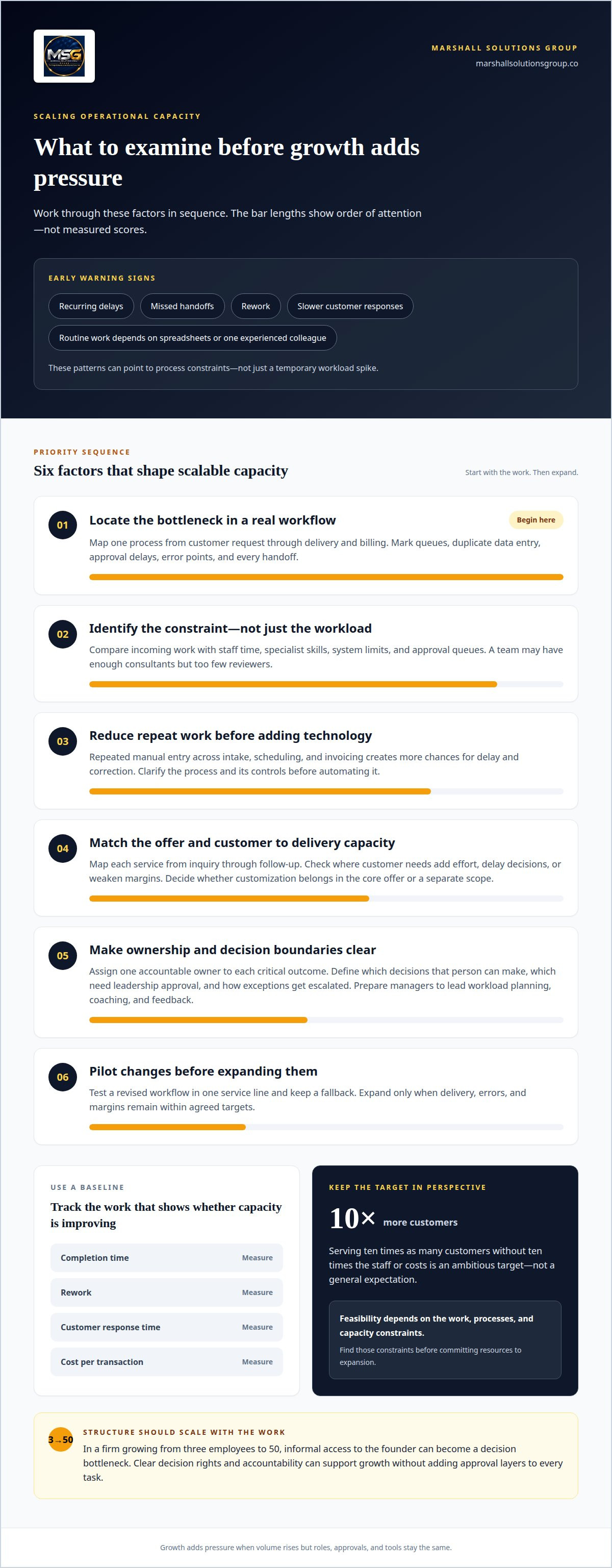
Recurring delays, missed handoffs, rework, and slower customer responses are clear warning signs. Employees may rely on spreadsheets or one experienced colleague to keep routine work moving. These patterns point to process constraints, not just a temporary spike in workload.
Processes struggle when expansion increases volume but roles, approvals, and tools stay the same. A Federal Reserve Board report on business growth notes that rapid growth can strain management information systems and put pressure on change controls and strategic planning.
Start redesign by mapping one workflow, from customer request through delivery and billing. Mark queues, duplicate data entry, approval delays, and error points. Assign an accountable person to each handoff. Establish a baseline using completion time, rework, customer response time, and cost per transaction. Pilot changes before rolling them out across operations.
Compare incoming work with staff time, specialist skills, system limits, and approval queues to assess capacity. A professional-services team may have enough consultants but too few reviewers. That bottleneck can delay delivery, prompt hiring, or leave suitable work unserved. Serving ten times as many customers without ten times the staff or costs is an ambitious target, not a general expectation; whether it is feasible depends on the work, processes, and capacity constraints. Identify those constraints before committing resources to expansion.
As demand grows, repeated manual tasks multiply. Entering client details separately for intake, scheduling, and invoicing creates more opportunities for delays and corrections. Track these touchpoints alongside errors, rework, and margin by service. Automation may free up capacity, but first clarify the process and controls. Otherwise, technology can speed up an inefficient workflow without protecting service quality.
Roll out changes in phases: test the revised workflow in one service line and keep a fallback. Expand once delivery, errors, and margins remain within agreed targets. A limited pilot can reduce disruption and reveal risks before broader implementation.
2. Aligning products, ideal customers, and internal processes
Growth is easier to manage when the offer, customer, and delivery model fit together. A professional-services firm may target larger clients while its review process still depends on one senior specialist. When business processes are not scaling with company growth, examine whether delivery requirements still match the clients and services the firm pursues. Map each service from inquiry through delivery and follow-up, noting where client needs add effort, delay decisions, or weaken margins.
Use buyer personas to define clients’ goals, pain points, buying criteria, and service expectations. Compare those needs with the work required to deliver each service. If a market segment repeatedly requests customized reporting, decide whether it strengthens the core offer or belongs in a separate scope. This helps leaders direct investment toward services the team can deliver consistently.
Custom software may support a tailored workflow when existing tools cannot meet defined requirements. Before investing, document what information each role needs, which decisions the workflow supports, and how to handle exceptions. Then consider whether configuring existing tools or making a simpler process change would suffice. Software built around unclear requirements can limit future changes and add maintenance work.
Choose automation or outsourcing only after clarifying responsibilities and quality expectations. Keep work that depends on client context or professional judgment. For example, a firm could standardize project status reports while leaving recommendations to a consultant’s judgment. Track client feedback and repeat business after process changes. These signals help leaders assess whether the operating model supports customer experience and retention as the firm enters new markets.
3. Building organizational structure and leadership
Growth changes how employees experience their roles. In a firm growing from three employees to 50, informal access to the founder can become a decision bottleneck. A sustainable structure makes accountability visible without adding approval layers to every task.
Start with the work, not a new organization chart. Identify critical workflows and assign one accountable owner to each outcome. Define the decisions that person can make, those requiring leadership approval, and how to escalate exceptions. For example, project leads might resolve routine staffing conflicts, while leaders retain authority over major client commitments. Clear decision rights reduce duplication and stalled opportunities.
How should companies scale hiring, onboarding, and team communication? Hire for the capabilities the strategy requires, then use a consistent onboarding plan tied to roles and workflows. Set regular communication routines, such as project reviews and manager check-ins, with clear owners and recorded decisions.
Prepare managers before expanding their authority. Set expectations for workload planning, coaching, performance feedback, and escalation. Without this preparation, new managers may continue specialist work while their teams lack direction. Leaders should also assess whether the organization has the skills to deliver its current services and pursue new opportunities.
Keep the structure connected to operating evidence. Review handoff delays, unresolved decisions, workload distribution, and client issues in leadership meetings. If the same approval repeatedly blocks delivery, change the decision boundary or assign a clear delegate. If communication breaks between teams, define the handoff and the information required. This focused effort helps organizational structure support execution, rather than adding process for its own sake. Marshall Solutions Group works with organizations on leadership structure and accountability.
Marshall Solutions Group: Organizational & Operational Improvement
Marshall Solutions Group helps growing professional-services firms address process breakdowns that slow delivery, blur accountability, or make quality harder to maintain. Our organizational and operational improvement work can focus on clarifying workflows, reducing unnecessary handoffs, and aligning responsibilities with operational needs.
When leaders need a clearer picture of constraints before choosing changes, we can help examine processes and responsibilities that need attention. We can also help connect operational changes to business priorities. The work and deliverables depend on the agreed scope.
Marshall Solutions Group shares updates on LinkedIn.
Build for the next stage of growth
Process redesign is an ongoing leadership responsibility, not a single cleanup. When your business processes aren't scaling with company growth, assign an executive owner to keep improvements tied to business priorities. Set regular review points to decide whether processes still support the work, customers, and decisions the organization needs.
We can support this work through Organizational & Operational Improvement, Growth Strategy & Business Development, or Program & Project Management. The right fit depends on whether the immediate need is to clarify constraints, align operational priorities, or help leaders put changes into practice. Responsibilities and deliverables are set out in the agreed scope.
Learn more about Marshall Solutions Group and our work supporting organizations through growth.
Frequently Asked Questions
What Does It Mean to Have Scalable Business Processes?
Scalable processes help a firm handle more work while keeping delivery dependable. For example, a client kickoff should give every project team the information it needs without relying on a partner’s memory. The process also needs a clear way to handle exceptions, such as a client changing priorities mid-project. Growth should not make routine work less predictable.
How Does Culture Affect Scaling?
Culture influences whether employees raise problems early or quietly work around them. When leaders reward constant firefighting, staff may hide process failures until clients feel the effects. Leaders can encourage better habits by treating early escalation as responsible, discussing mistakes without blame, and following through on agreed changes. These behaviors make accountability part of daily work.
What Is a Scaling Plan?
A scaling plan links business goals to the organizational changes needed to support them. It identifies which services or markets to prioritize, what capabilities delivery requires, and who owns major decisions. It should also set review points so leaders can pause or adjust an initiative as demand, capacity, or client needs change.
Which business processes commonly become bottlenecks during growth?
In professional services, bottlenecks often show up in proposal review, project staffing, client approvals, quality control, and invoice preparation. If one partner must approve every proposal, for example, new opportunities may wait even when delivery teams have capacity. Trace delays from the moment work enters the firm through completion; the slowest handoff may be outside the team initially blamed.
How can a company assess whether its processes are ready to scale?
Test readiness against real work, not an idealized procedure. Review recent projects across different service lines and note where decisions waited, information went missing, or teams repeated work. Ask the employees who perform each step to identify exceptions the written process overlooks. A process is more ready when ownership is clear and teams can resolve routine issues without constant escalation.
Disclaimer
The information provided in this article is for general informational and educational purposes only and does not constitute legal, financial, accounting, engineering, or other professional advice. Marshall Solutions Group, Inc. makes no representations or warranties regarding the completeness or applicability of this information to any specific situation. Readers should consult appropriately qualified professionals before making decisions requiring specialized professional advice.