Sustaining Process Improvements With SOPs and Strategic Goals
By Chelvis “CJ” Marshall, President & Founder
Learn how to sustain process improvements after a project by updating SOPs, training teams, assigning ownership, and tracking results against strategic goals.

Article by
Chelvis “CJ” Marshall
Chelvis "CJ" Marshall is President and Founder of Marshall Solutions Group (MSG), a veteran-owned management consulting firm helping organizations strengthen leadership, improve operations, and turn strategy into disciplined execution. MSG specializes in Organizational & Operational Improvement, Growth Strategy & Business Development, and Program & Project Management.
A retired U.S. Navy Senior Chief, CJ served as the senior enlisted engineering leader aboard USS McCampbell (DDG-85), overseeing a 137-person engineering department responsible for mission-critical shipboard systems. He subsequently advanced into Fortune 500 enterprise sales and leadership, bringing operational discipline and commercial experience to complex business environments. He is completing his MBA at Syracuse University's Whitman School of Management.
CJ's approach reflects a central principle: strategy creates direction, but leadership, accountability, and disciplined execution determine whether organizations can deliver. His work focuses on helping leadership teams establish the structures, operating practices, and management discipline needed for sustained performance.
A process improvement isn’t finished when the project closes. Sustaining process improvements after a project means embedding effective changes in routine work, documenting the revised procedure, training the people who use it, and tracking whether results hold. Continuous improvement is the ongoing cycle of measuring performance, learning from results, and adapting the process.
A project may deliver a change, but leaders determine whether it lasts. A procedure that adds steps without advancing a business priority is unlikely to stick; a change linked to clear strategic goals has a reason to remain. This article explains how to incorporate improvements into standard operating procedures, assign ownership, and connect process measures to organizational objectives. It also covers what to monitor after implementation so teams can address drift rather than treating project closure as proof that the work is done.
Key Takeaways
- Improvement lasts when teams establish a performance baseline, assign process ownership, and keep reviewing results after project close.
- Update procedures to reflect proven changes, then support consistent use with clear training and handoffs.
- Connect process measures to strategic priorities so leaders can tell whether a change is improving organizational performance.
- When improvements stall between planning and daily execution, process improvement support can help align procedures, accountability, and performance measures.
Table of Contents
1. What is the continuous improvement process?
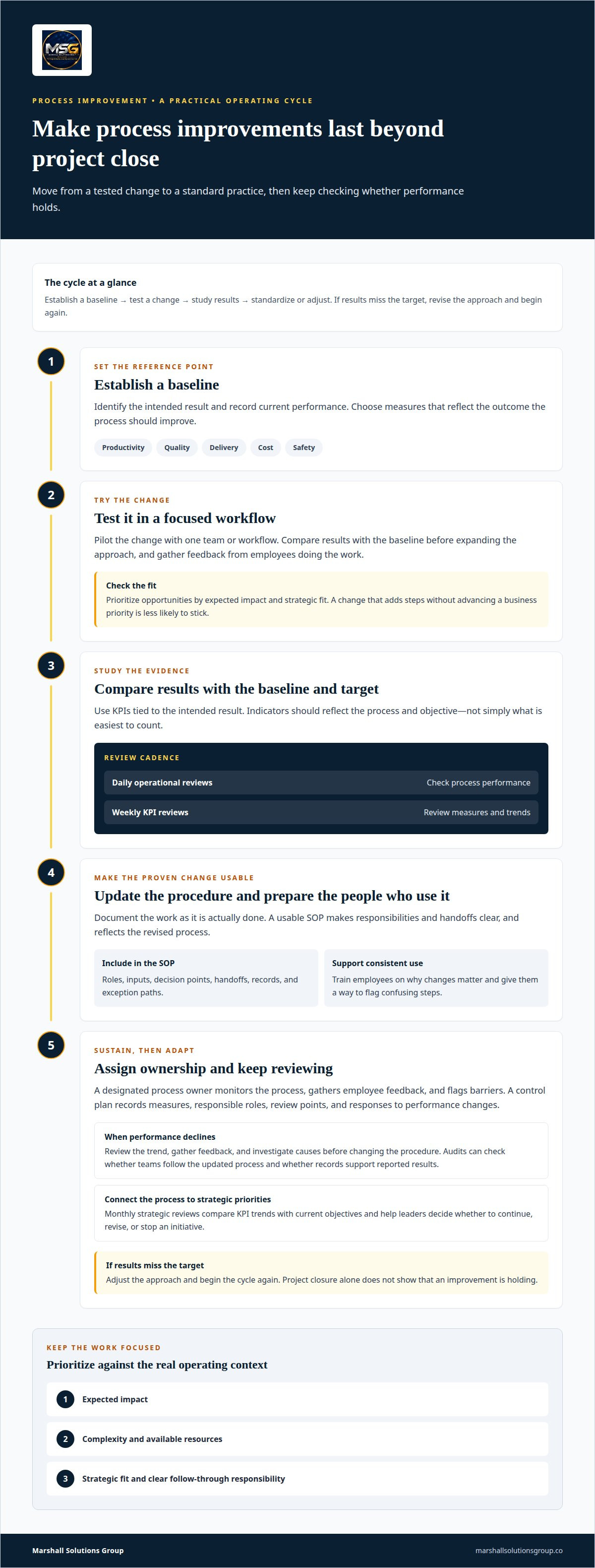
Continuous improvement follows a repeating cycle: establish a baseline, test a change, study the results, then standardize or adjust. Plan-Do-Check-Act gives teams a structure. When results miss the target, revise the approach and begin again. Sustaining process improvements after a project means treating changes as ongoing work, not a handoff document. Small daily changes may be implemented quickly. Prioritize opportunities by expected impact and strategic fit.
After handoff, a designated process owner monitors the process and its related subprocesses. According to the United States General Accounting Office, that owner is accountable for the process’s operation and improvement. The owner gathers feedback from employees doing the work and flags barriers. A consultant can pilot a change with one team or workflow, compare results against the baseline, and revise the approach before broader implementation.
Track KPIs tied to the intended result, such as productivity, quality, delivery, cost, or safety. Compare performance with the baseline and target in daily operational reviews and weekly KPI reviews. A control plan records the measures, responsible roles, review points, and responses to performance changes. Audits can then check whether teams follow the updated process and whether records support reported results.
When performance declines, the process owner reviews the trend, gathers feedback, and investigates causes before changing the procedure. Improvements often fail to last when ownership is unclear, training is incomplete, or the new process conflicts with daily demands. We can help establish monitoring routines, address handoff gaps, and keep improvement initiatives connected to strategic priorities.
2. Documenting and updating standard operating procedures
A procedure sustains an improvement only when it reflects the work people actually do. During an engagement, we observe the revised process, gather input from employees and supervisors, and document the steps in sequence. The SOP should identify roles, required inputs, decision points, handoffs, records, and exception paths. For example, a customer-service procedure can specify who handles an unresolved request and where its status is recorded.
Next, we compare the draft with work across teams and shifts. This can reveal local differences that may undermine consistent use. The organization should set documentation rules for naming, version control, approvals, review triggers, and change history. These standards help employees identify the current procedure and understand what changed. The process owner approves updates when responsibilities, tools, or objectives change.
Documentation alone won’t maintain a new practice. We can help prepare training materials, brief supervisors, and establish a feedback route for employees using the revised procedure. Training should explain why each change matters, not simply tell employees to follow new instructions. Employees can flag confusing steps and suggest corrections. The organization also needs to allocate time and resources for training and controlled updates.
To maintain progress, connect each SOP to the relevant role and performance measure. We can help define how teams record deviations, feedback, and approved revisions. This creates a usable change record instead of an outdated document library. This work can be part of our Process Improvement & Performance support.
3. Aligning improvements with strategic goals
A faster process has limited value if it doesn’t advance an organizational objective. We connect proposed initiatives to strategic priorities, such as improving delivery reliability, protecting quality, or supporting growth. Then we define the intended business result and identify measures that show progress. This makes it easier to prioritize improvement efforts alongside available resources and competing work.
Next, we trace how team-level indicators contribute to organization-wide KPIs. If reliable delivery is a strategic objective, for example, a team might track missed handoffs or rework alongside the broader delivery measure. Indicators should reflect the process and objective, not simply what is easiest to count. This helps leaders distinguish activity from meaningful results and adjust initiatives when measures don’t support the intended outcome.
Strategic alignment requires regular management attention. Monthly strategic reviews can compare KPI trends with current objectives, surface conflicts, and determine whether to continue, revise, or stop an initiative. Employees closest to the work can explain why a measure changed and whether new practices are practical. Their feedback helps build a culture where improvement serves business priorities rather than becoming a separate program.
Industry conditions and organizational priorities can shift, so improvement plans need room to adapt. We can help leaders assess initiatives against expected impact, complexity, resources, and strategic fit, then assign clear follow-through responsibilities. This keeps attention on business outcomes and helps teams avoid making one task more efficient at the expense of another. Leaders can use this decision discipline to keep improvement work focused as priorities evolve.
Marshall Solutions Group: Process Improvement & Performance
Marshall Solutions Group helps organizations turn process changes into operating practices that support sustained performance. Our process improvement work can help when a project has produced a change, but ownership, procedures, or follow-through remain unclear.
Depending on the need, Organizational & Operational Improvement can clarify where execution is breaking down and support practical changes. Program & Project Management can help manage implementation and follow-through. The agreed scope defines the work; not every engagement requires the same support.
Consider outside support when improvements keep fading after project close, teams follow different procedures, or performance measures no longer reflect strategic priorities. The focus is practical: clarify accountability, support implementation, and establish routines that keep the change visible. To discuss process improvement needs, contact Marshall Solutions Group.
Make the next improvement part of how work gets done
Project close is a decision point: let the change fade into routine habits, or keep leadership attention on whether it is working. Sustaining process improvements after a project takes follow-through as priorities, workloads, and teams change. The next step is to decide who remains accountable for the improvement and how leaders will address obstacles.
If ownership is unclear or progress has stalled, we can help clarify the operational challenge and identify a practical path forward. Our organizational and operational improvement, growth strategy and business development, and program and project management services can help organizations connect priorities with execution.
Keep attention on the result your organization needs. Contact Marshall Solutions Group to discuss a practical next step.
Frequently Asked Questions
What is the continuous improvement process?
Continuous improvement is a recurring management practice for finding and addressing gaps in how work gets done. For example, a team handling invoice approvals might examine where requests stall, test a change, and review whether delays decrease. The process continues as business needs shift; it isn’t a project label or a single push to change procedures.
How can professional support help sustain process improvements after a project ends?
Professional support can carry improvement work into routine management by clarifying who owns follow-through, which decisions need leadership attention, and how unresolved barriers are escalated. For instance, we can help establish a handoff between the project team and the manager responsible for daily operations. That makes continued oversight part of normal accountability, not an informal expectation.
How can professional support help embed process improvements into daily operations?
We can connect the revised process to existing work routines, such as team check-ins, supervisor reviews, and onboarding. If a new customer-issue workflow depends on timely escalation, for example, we can help define who raises the issue and where it appears in the team’s regular review. This reduces reliance on memory or project-specific reminders.
How can a consultant document and standardize process improvement changes?
We can turn the approved workflow into a usable procedure that identifies roles, decisions, required records, and exception handling. We can also define how employees access the current version and how proposed edits are reviewed. For example, if teams use different approval paths, the documented standard can clarify shared steps while identifying authorized exceptions.
How can professional support help prevent teams from reverting to old processes?
Our support can address conditions that make the old method easier to use, including unclear instructions, competing priorities, or unresolved training needs. We can review where employees depart from the agreed process, discuss the reasons with supervisors, and help leaders address obstacles. If the revised method creates unnecessary work, feedback should prompt a controlled adjustment rather than a silent return to the old process.
Disclaimer
The information provided in this article is for general informational and educational purposes only and does not constitute legal, financial, accounting, engineering, or other professional advice. Marshall Solutions Group, Inc. makes no representations or warranties regarding the completeness or applicability of this information to any specific situation. Readers should consult appropriately qualified professionals before making decisions requiring specialized professional advice.