Cross-Functional Communication: Clarify Roles and Goals
By Chelvis “CJ” Marshall, President & Founder
Learn how to improve cross functional communication with clear roles, aligned goals, and routines that surface dependencies and keep decisions moving.

Article by
Chelvis “CJ” Marshall
Chelvis "CJ" Marshall is President and Founder of Marshall Solutions Group (MSG), a veteran-owned management consulting firm helping organizations strengthen leadership, improve operations, and turn strategy into disciplined execution. MSG specializes in Organizational & Operational Improvement, Growth Strategy & Business Development, and Program & Project Management.
A retired U.S. Navy Senior Chief, CJ served as the senior enlisted engineering leader aboard USS McCampbell (DDG-85), overseeing a 137-person engineering department responsible for mission-critical shipboard systems. He subsequently advanced into Fortune 500 enterprise sales and leadership, bringing operational discipline and commercial experience to complex business environments. He is completing his MBA at Syracuse University's Whitman School of Management.
CJ's approach reflects a central principle: strategy creates direction, but leadership, accountability, and disciplined execution determine whether organizations can deliver. His work focuses on helping leadership teams establish the structures, operating practices, and management discipline needed for sustained performance.
Cross-functional work can stall even when every department is capable and committed. Often, the issue is the operating rhythm: teams make decisions on different timelines, share updates inconsistently, or discover dependencies too late. Leaders asking how to improve cross-functional communication need more than another standing meeting. They need a cadence that links conversations to decisions and follow-through.
A cross-functional team brings people from different functions together to handle work that spans departmental boundaries. Its communication cadence should make coordination part of normal operations, not an extra layer of administration. The key is to establish clear ownership, align work across teams, and respond when communication breaks down. A practical operating rhythm keeps shared priorities, responsibilities, and decisions visible as conditions change.
Key Takeaways
- Cross-functional teams work best when people understand how their contributions connect to a shared outcome.
- Set clear ownership, expectations, and goals so work can move across departments without avoidable confusion.
- Use consistent communication routines and feedback to surface dependencies, resolve disagreements, and keep decisions moving.
- When communication problems point to wider process or accountability gaps, structured improvement support can help address the underlying causes.
Table of Contents
What Is a Cross-Functional Team?
Cross-functional collaboration brings individuals from different functions together to deliver a shared outcome. A team might combine sales, operations, finance, and customer support to launch a service. Each person contributes expertise the others need, while the team shares responsibility for work no single department can complete alone.
Effective teamwork starts with the right people: include those whose responsibilities, knowledge, and decision authority match the work. Define the outcome, assign an owner to each deliverable, and agree on how members will share updates. For example, a launch team can use one project platform to record decisions, dependencies, deadlines, and unresolved issues. A shared record helps departments coordinate without relying on separate conversations that leave others guessing.
Recognize contributions by connecting individual work to the shared result. In a launch review, explain how operations prepared delivery, finance clarified resource limits, and sales relayed customer needs. Make recognition specific and tied to the work, not merely attendance. This shows how each function supports the outcome and helps teams bring relevant expertise into future work earlier.
To improve cross-functional communication, establish clear ownership, an agreed update channel, and a consistent way to document decisions. Test the process by asking whether the team can identify its next handoff and who owns it. Standardize repeatable steps, such as intake, approval, and handoffs, so teams know what information to provide and when. Keep the process consistent, then adjust it when feedback exposes a gap. Standardization reduces avoidable confusion without requiring every function to work identically.
Defining Roles, Goals, and Expectations
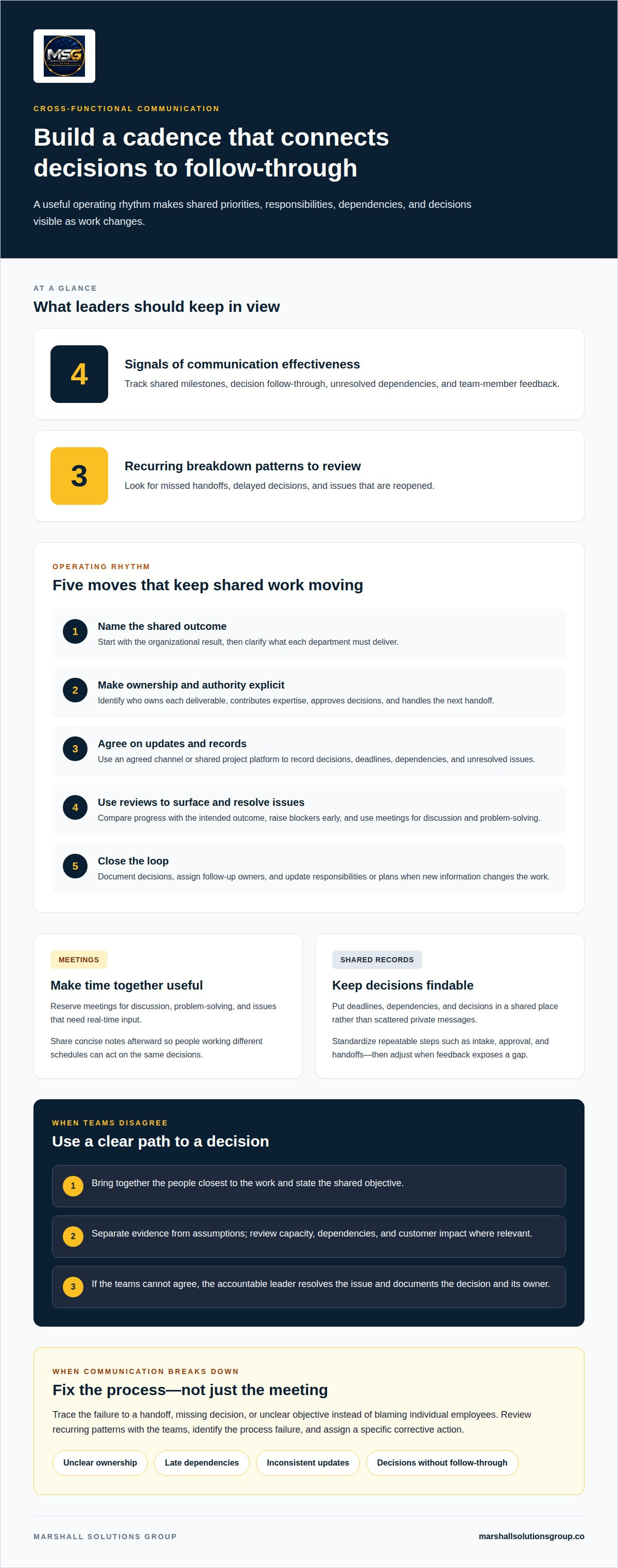
Start with the organizational outcome, then specify what each department must deliver. Define roles by their work, decision authority, and handoffs, rather than by title alone. A responsibility chart can show who owns each deliverable, who contributes expertise, and who approves a decision. This makes ownership explicit and prevents teams from assuming someone else will handle a critical action.
Connect those responsibilities to shared goals. Cascade the organization’s priority into department outcomes, team commitments, and individual actions. For example, a customer-retention goal might require support to identify recurring issues, product teams to prioritize fixes, and sales to relay customer feedback. Each group should understand how its knowledge and work contribute to the result.
Set expectations for how members will raise challenges and opportunities. Agree on milestones, decision points, and a feedback loop that surfaces blockers early. At each review, compare progress with the intended outcome, record decisions, and assign follow-up owners. When new information changes the work, update responsibilities or plans instead of letting outdated assumptions persist.
Measure communication effectiveness through shared milestones, decision follow-through, unresolved dependencies, and team-member feedback. Compare planned actions with completed actions, then look for where delays or rework occur. These patterns can show whether teams need clearer ownership, faster decisions, or a more effective way to share information.
Communication Breakdowns in Cross-Functional Teams
Breakdowns often begin when departments work from different priorities, terminology, or reporting routines. Sales may promise a delivery date without confirming operations capacity, leaving operations under pressure to meet an expectation it never accepted. To improve cross-functional communication, trace the failure to a handoff, missing decision, or unclear objective instead of blaming individual employees. Identifying the process breakdown shows what needs to change.
Conflicts need a clear decision process. Bring together the people closest to the work, state the shared objective, and separate evidence from assumptions. For example, if finance and product disagree about a launch date, review capacity, dependencies, and customer impact. If the teams cannot agree, the accountable leader should resolve the issue and document both the decision and its owner.
Remote and hybrid teams need agreed communication channels and written records. Use a shared project platform for decisions, deadlines, and dependencies; reserve meetings for discussion, problem-solving, and issues requiring real-time input. After each meeting, share concise notes so employees on different schedules can work toward the same objectives. Keep final decisions out of scattered private messages.
Leaders can support effective cross-team communication by making it safe to raise risks early and ensuring everyone has a voice. Diverse expertise helps only when people can challenge assumptions without making disagreement personal. Track recurring missed handoffs, delayed decisions, and reopened issues. Review the patterns with the teams, identify the process failure, and assign a specific corrective action. This turns communication into operational improvement, rather than another meeting without follow-through.
How Marshall Solutions Group Supports Process Improvement
We help organizations address cross-functional friction through Organizational & Operational Improvement. This work can help when recurring handoff failures, unclear ownership, or inconsistent routines prevent teams from delivering agreed outcomes. We focus on the operating process: where work stalls, how decisions move, and which responsibilities need clearer definition. The aim is to connect practical improvements to organizational priorities, not add procedures without a clear purpose.
Depending on the need, Organizational & Operational Improvement can help leaders connect strategic priorities to operating expectations. An assessment can provide a structured review of leadership and operational issues before decisions about next steps. For cross-functional work, that may include examining how teams share information, escalate dependencies, and follow through on decisions. Findings can inform changes to processes, roles, or management routines. Deliverables and responsibilities are established through the agreed scope, and implementation support depends on that scope.
Standardization should make coordination easier to sustain, not create unnecessary bureaucracy. The work may focus on clarifying handoffs, strengthening accountability, or aligning management routines with what teams need to complete. Leaders should identify the operational issue, the teams it affects, and the decisions that need to move. That gives the work a practical starting point and keeps improvement connected to execution.
Explore an assessment for organizational and operational improvement.
Make Cross-Functional Alignment Part of the Operating System
Cross-functional communication should not depend on individual effort or a single project lead. Build it into how leaders set priorities, review work, and resolve issues. Choose a recurring management routine where teams can raise dependencies and confirm decisions. Keep the routine focused on action, with clear ownership for follow-through.
If you’re deciding how to improve cross-functional communication across your organization, look beyond the messages themselves. Persistent friction may point to unclear leadership expectations, competing priorities, or operating processes that no longer fit the work. Addressing the underlying issue can make collaboration easier to sustain.
Marshall Solutions Group supports organizational and operational improvement. The right fit depends on the challenge and agreed scope. Explore an organizational and operational improvement assessment to identify a practical next step.
Frequently Asked Questions
Why Is It Important to Debunk Collaboration Misconceptions?
Misconceptions can turn collaboration into extra meetings without shared accountability. Inviting several departments does not automatically create joint ownership. Leaders need to clarify who can decide, whose input is required, and how disagreements will be resolved. That clarity helps teams collaborate without confusing participation with authority.
How Can Teams Set Shared Goals and Clarify Roles Across Departments?
Translate a company priority into a result that multiple departments can influence, then assign each team a specific contribution. For example, improving customer response times could involve support tracking response issues and operations addressing workflow bottlenecks. Name one accountable owner for the overall result, clarify approval authority, and revisit assignments when dependencies or priorities change.
What Communication Tools Work Best for Cross-Functional Teams?
Choose tools according to the work they need to support. A project-management platform can track owners, deadlines, and dependencies; messaging works for quick coordination; video calls can help resolve complex issues. Keep the authoritative decision record in one shared location. If people have to search email, chat, and meeting notes to find the latest decision, the tool setup is creating friction.
How Often Should Cross-Functional Teams Hold Meetings or Check-Ins?
Set meeting frequency according to decision pace, dependencies, and project risk instead of defaulting to a standing meeting for every team. Fast-moving work may need frequent, brief check-ins; stable work may need fewer. Schedule a review before consequential milestones and use concise written updates between meetings. Reassess the cadence when blockers or missed handoffs become more common.
Disclaimer
The information provided in this article is for general informational and educational purposes only and does not constitute legal, financial, accounting, engineering, or other professional advice. Marshall Solutions Group, Inc. makes no representations or warranties regarding the completeness or applicability of this information to any specific situation. Readers should consult appropriately qualified professionals before making decisions requiring specialized professional advice.