How to Scale a Business With Less Operational Friction
By Chelvis “CJ” Marshall, President & Founder
Learn how to scale a business without operational chaos by clarifying ownership, improving processes, and using AI and operating routines to manage growth.

Article by
Chelvis “CJ” Marshall
Chelvis "CJ" Marshall is President and Founder of Marshall Solutions Group (MSG), a veteran-owned management consulting firm helping organizations strengthen leadership, improve operations, and turn strategy into disciplined execution. MSG specializes in Organizational & Operational Improvement, Growth Strategy & Business Development, and Program & Project Management.
A retired U.S. Navy Senior Chief, CJ served as the senior enlisted engineering leader aboard USS McCampbell (DDG-85), overseeing a 137-person engineering department responsible for mission-critical shipboard systems. He subsequently advanced into Fortune 500 enterprise sales and leadership, bringing operational discipline and commercial experience to complex business environments. He is completing his MBA at Syracuse University's Whitman School of Management.
CJ's approach reflects a central principle: strategy creates direction, but leadership, accountability, and disciplined execution determine whether organizations can deliver. His work focuses on helping leadership teams establish the structures, operating practices, and management discipline needed for sustained performance.
Growth doesn’t create operational chaos by itself. It reveals gaps in how work is assigned, decisions are made, and problems are resolved. As customer expectations rise and teams take on more responsibility, informal habits that once seemed efficient can cause delays. Learning how to scale a business without operational chaos means improving how the organization runs, not asking people to work faster or adding rules for their own sake.
AI can surface friction and reduce repetitive coordination, but it can’t determine priorities, establish accountability, or fix a poorly designed process on its own. Leaders need to decide where technology can support the work and where human judgment is essential. This article explains how to use AI thoughtfully, establish a repeatable operating cadence, and prevent growing complexity from becoming constant firefighting. You’ll learn what to examine before expanding and how to make operational improvements part of everyday work.
Key Takeaways
- Test whether your current processes, roles, and capacity can handle more demand before pursuing faster growth.
- Document how work should be completed and clarify ownership before adding technology or automation.
- Use a consistent operating cadence to spot bottlenecks, address manual-work debt, and keep teams aligned as complexity grows.
- AI can help manage scaling friction, but it works best when it supports clear processes and accountable decisions.
Table of Contents
How to Scale a Business Without Operational Chaos
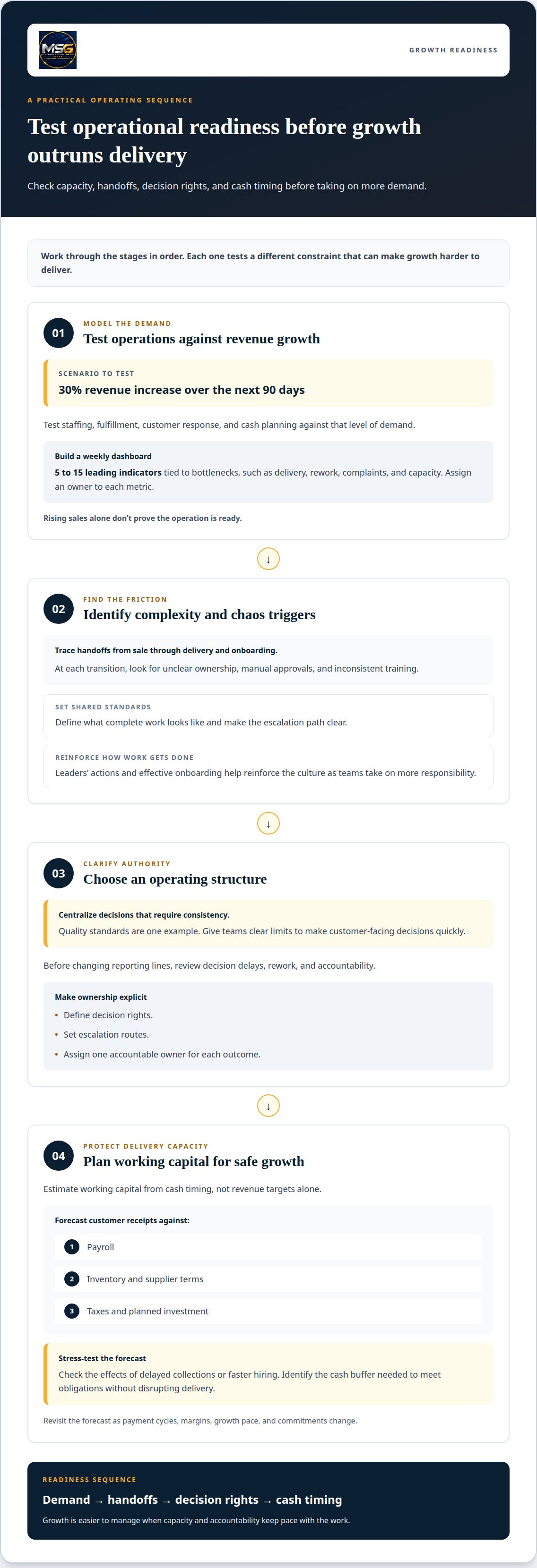
Test capacity before growth outpaces delivery. Clear ownership, reliable processes, and working capital need to keep pace.
-
Test Operations Against Revenue Growth
Model a 30% revenue increase over the next 90 days. Test staffing, fulfillment, customer response, and cash planning against demand. Build a weekly dashboard with 5 to 15 leading indicators tied to bottlenecks, such as delivery, rework, complaints, and capacity. Give each metric an owner; rising sales alone don't prove readiness.
-
Identify Growth Complexity and Chaos Triggers
Map handoffs from sale through delivery and onboarding. Flag unclear ownership, manual approvals, and inconsistent training. Growth adds customers, decisions, coordination, and exceptions, exposing the limits of informal routines. Protect quality and customer service with shared completion standards and a clear escalation path. Reinforce culture through leaders’ actions and effective onboarding.
-
Choose an Operating Structure
Centralize decisions that require consistency, such as quality standards. Give teams clear limits to make customer-facing decisions quickly. Before changing reporting lines, review decision delays, rework, and accountability. Build a structure that can scale with defined decision rights, escalation routes, and one accountable owner for each outcome.
-
Plan Working Capital for Safe Growth
Estimate working capital based on cash timing, not revenue targets alone. Forecast customer receipts against payroll, inventory, supplier terms, taxes, and planned investment. Stress-test delayed collections or faster hiring, and identify the cash buffer needed to meet obligations without disrupting delivery. Revisit the forecast as payment cycles, margins, growth pace, and commitments change.
How to Build a Repeatable Operating Cadence
Set a weekly review cadence, then improve the work before automating it. A clear operating system reduces missed handoffs and makes growth easier to manage.
-
Map Processes and Audit Operations
Map a process from request to completion, including every handoff. Review the people, processes, and technology involved. Note where approvals stall, information is entered more than once, or one employee is the only person who knows the next step. This map reveals bottlenecks and whether the process is failing because of unclear roles, weak instructions, or tool limitations.
-
Document Processes and Procedures
Document repeatable work in a concise standard operating procedure. Define the trigger, owner, required inputs, completion standard, and escalation path. Use a real task, such as onboarding, to make the instructions specific enough for a trained employee to follow. Ask the people doing the work to review them: a founder’s assumptions may leave out essential steps.
-
Systematize Before Adding Technology
Standardize steps and decision rights before buying software. First remove unnecessary approvals and clarify who updates each record. Then choose technology to support the defined process, not to conceal a broken one. Fractional COO support can help structure this work when leaders need focused operating support. Assign internal owners for ongoing use.
-
Address Manual Process Debt
Track repeated copying, spreadsheet reconciliation, and follow-up reminders as operational debt. Each workaround adds maintenance and increases the risk of losing information. Prioritize manual tasks that delay customer delivery or obscure accountability. Review progress weekly, retire obsolete procedures, and use process improvement support to address persistent bottlenecks.
Why Operational Complexity Creates Chaos as Businesses Grow
Growth adds coordination demands alongside sales. Without clear ownership, success can consume capacity and lead to constant firefighting.
- Trace one customer handoff. Follow a project from sale through delivery and support. At each transition, identify who owns the next decision and what information they need. If teams use separate records, updates can conflict and leaders lose visibility. Eventually, managing exceptions takes time away from customer work.
- Measure the cost of communication gaps. Missed updates can delay work, strain customer relationships, and contribute to lost business. Treat them as process failures to investigate, not isolated reminders to send.
- Check whether growth is scalable. Compare incoming work with team capacity, decision speed, and service quality. A growing company may add hiring before clarifying roles, creating more handoffs without fixing delays. A fractional leader or project manager can help establish ownership when internal management capacity is stretched.
- Protect sustainable performance. Review recurring delays, customer complaints, and rework in a regular leadership meeting. Assign an owner and corrective action to each repeated issue. This keeps the response focused on causes, such as unclear approvals or duplicate data, rather than constant escalation. Compare patterns across teams before adding management layers or tools.
How Marshall Solutions Group Supports Operational Improvement
We help leadership teams address operational friction when growth exposes gaps in accountability, processes, or execution. Our support may fit when routine work depends on informal decisions, ownership is unclear, or leaders lack the capacity to coordinate improvements.
An Operational Assessments & Business Diagnostics engagement can examine how work moves across roles and processes, helping leaders identify constraints to address. Process Improvement & Performance focuses on making work more consistent and manageable. The right scope depends on the challenge: a specific process issue differs from broader leadership or operating model needs.
When strategy is in place but execution stalls, Strategy & Operations Consulting can connect priorities with accountable actions and operating routines. Organizational Leadership & Change may fit when growth changes responsibilities, decision rights, or how teams coordinate. These are distinct needs, not automatic packages. The agreed scope defines responsibilities and deliverables. It may include support implementing selected improvements.
The work should give leaders clearer decisions, named owners, and a practical path forward, not another layer of reporting. Start with the issue affecting delivery, then determine whether assessment, consulting, or implementation support fits. Adding structure without removing friction can burden teams rather than improve execution.
Contact Marshall Solutions Group to discuss operational improvement and whether an assessment fits your organization’s needs.
Make the Next Stage of Growth Deliberate
Growth becomes easier to manage when leaders treat operating structure as part of business strategy, not an administrative afterthought. Decide which constraint deserves attention first and who will own the change. That turns the question of how to scale a business without operational chaos into a practical leadership decision, not simply a technology project or a demand for more effort.
Organizational & Operational Improvement can help address operating practices that limit execution. Growth Strategy & Business Development can connect priorities with action, while Organizational & Operational Improvement can support changes in roles and ways of working. The right starting point depends on the challenge your organization needs to address.
Choose a next step that fits the work ahead. Contact Marshall Solutions Group to discuss your operational priorities and whether an assessment on the relevant service page is appropriate. Growth can move forward with clearer decisions and stronger ownership.
Frequently Asked Questions
How can you use AI to manage scaling friction?
Use AI to reduce coordination work around a process with clear rules. For example, it can help categorize recurring support requests, summarize meeting notes as assigned actions, or draft an initial version of an internal procedure. A responsible manager must review outputs, correct errors, and decide what to do. AI supports accountability; it doesn’t replace it.
When do you need a fractional integrator to scale?
Consider fractional COO support when a founder spends more time coordinating work than setting direction, or when cross-team decisions routinely stall. Within an agreed scope, the role can help establish priorities, clarify decision rights, and maintain follow-through. It may not fit when the core issue is a single process that an accountable internal manager can resolve.
Why does scaling feel like your business is falling apart?
Scaling can expose informal dependencies that were manageable when fewer people handled the work. A new manager may not know which promises were made to customers, while key decisions still rest with the founder. Teams create workarounds, and small inconsistencies spread. These are signs that responsibilities and information flow haven’t kept pace with demand.
What are the key steps to scale a business without operational chaos?
Start by choosing one growth constraint, such as slow customer onboarding or inconsistent delivery. Assign an accountable owner, define the intended outcome, and set a review cadence. Then improve the process, train the people doing the work, and track whether the change holds under real demand. Expand the approach only after the initial improvement works consistently.
Which business processes should be standardized before scaling?
Standardize processes that directly affect customer experience, cash flow, or risk. Examples include qualifying incoming work, approving discounts, handing a sale over to delivery, handling complaints, and checking completed work before handoff. Define the required information, decision owner, and exception path for each. Leave room for judgment when customer needs vary, but make the boundaries clear.
Disclaimer
The information provided in this article is for general informational and educational purposes only and does not constitute legal, financial, accounting, engineering, or other professional advice. Marshall Solutions Group, Inc. makes no representations or warranties regarding the completeness or applicability of this information to any specific situation. Readers should consult appropriately qualified professionals before making decisions requiring specialized professional advice.