Operational Improvements to Increase Business Value Through Profitability
By Chelvis “CJ” Marshall, President & Founder
Operational improvements to increase business value start by finding waste, improving workflows, and using financial measures to improve profitability.

Article by
Chelvis “CJ” Marshall
Chelvis "CJ" Marshall is President and Founder of Marshall Solutions Group (MSG), a veteran-owned management consulting firm helping organizations strengthen leadership, improve operations, and turn strategy into disciplined execution. MSG specializes in Organizational & Operational Improvement, Growth Strategy & Business Development, and Program & Project Management.
A retired U.S. Navy Senior Chief, CJ served as the senior enlisted engineering leader aboard USS McCampbell (DDG-85), overseeing a 137-person engineering department responsible for mission-critical shipboard systems. He subsequently advanced into Fortune 500 enterprise sales and leadership, bringing operational discipline and commercial experience to complex business environments. MBA Candidate, Syracuse University, Whitman School of Management | December 2026 (Capstone in Progress)
CJ's approach reflects a central principle: strategy creates direction, but leadership, accountability, and disciplined execution determine whether organizations can deliver. His work focuses on helping leadership teams establish the structures, operating practices, and management discipline needed for sustained performance.
Profitability doesn’t improve simply because a business gets busier. Operational improvements to increase business value begin by finding where time, effort, and resources are spent without creating enough value, then addressing the processes behind the waste. Strengthen financial oversight and assign clear ownership for each change.
Growth, new systems, and cost reductions can help, but only when they address a real operating problem. This article explains how to identify inefficiencies, improve workflows before automating them, and use consistent financial measures to guide decisions. Stronger management routines and less dependence on the owner can also make performance more reliable and the business easier to scale.
Key Takeaways
- Map how work moves through the business to find delays, rework, and effort that doesn’t create customer value.
- Document critical processes and responsibilities so work can continue consistently when key people are unavailable.
- Use financial reporting to see which offerings and activities support healthy margins, then direct attention accordingly.
- Turn improvement priorities into owned actions with clear measures and regular progress reviews.
Table of Contents
1. What Tools Can Identify Inefficiencies in My Business?
Map one recurring workflow, such as fulfilling a customer order. Record each step, the responsible role, handoffs, approvals, and delays. Compare the intended process with the work as it actually happens. Rework, unclear ownership, and waits between teams can reveal inefficiencies that broad performance reports miss. Track processing time and errors before making changes. That baseline helps show whether a change improves efficiency or simply shifts the problem elsewhere.
Document standard operating procedures for work that relies on individual memory. A useful procedure identifies the owner, required inputs, decision points, and expected output. For example, an order-handling procedure can specify who resolves incomplete information and when an order moves forward. Compare the procedure with employees’ actual work, then close any gaps. Clear procedures make work easier to teach and help the business operate through staff changes or an owner’s absence. They can also reduce dependence on the founder, supporting a more reliable transition and valuation.
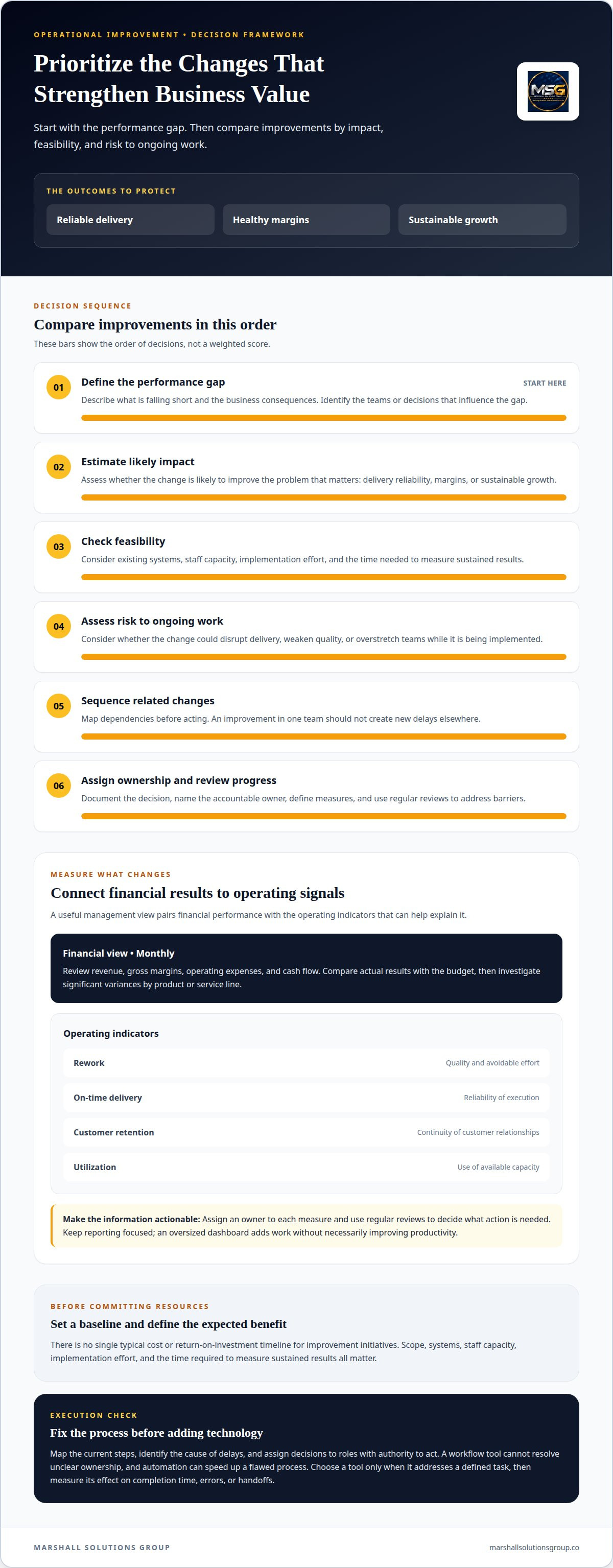
Assess people, processes, and technology together. A workflow tool cannot resolve an unclear approval role, and automation can speed up a flawed process. First map the current steps, identify the cause of delays, and assign each decision to a role with authority to act. Then decide whether a standardized workflow or appropriate technology can address the problem. Link each tool to a defined task and measure its effect on completion time, errors, or handoffs.
Inventory and supply chain improvements can free cash tied up in excess stock and reduce delays that interrupt sales. Map how purchasing, receiving, storage, and fulfillment connect, then look for where inventory accumulates or deliveries stall. Align replenishment decisions with demand and supplier reliability instead of optimizing one step in isolation. Better flow can support cash flow, consistent delivery, and buyer confidence in the business’s ability to operate. These operating strengths can contribute to business value.
2. Profitability and disciplined financial management
Start with a monthly view of revenue, gross margins, operating expenses, and cash flow. Compare actual results with the budget, then investigate significant variances by product or service line. This helps show whether growth improves profitability or adds work without enough margin. Review pricing, delivery effort, and recurring expenses together before cutting spending. A reduction that weakens quality or capacity can also hurt revenue.
Management reporting should connect financial results with operating indicators. Track measures such as rework, on-time delivery, customer retention, and utilization alongside margins. Assign an owner to each measure and use regular reviews to decide what action to take. Useful management information supports decisions; an oversized dashboard adds reporting work without improving productivity.
There is no single typical cost or return-on-investment timeline for operational improvement initiatives. Scope, existing systems, staff capacity, implementation effort, and the time needed to measure sustained results all matter. Before committing resources, establish a baseline and define the expected operational or financial benefit.
Quality improvements can protect margins by reducing rework, errors, and avoidable waste. More consistent delivery can support customer retention, while recurring quality failures may lead customers to take their business elsewhere. Track delivery performance and customer feedback to see whether changes are improving results.
When valuing a company, buyers may assess earnings using a multiple, along with leadership strength, reliable reporting, and operational risk. A capable management team and documented succession plan can reduce reliance on the owner and support continuity during a sale or transition.
Change also requires active stakeholder engagement. Explain why a process is changing, involve affected employees in testing it, and assign leaders to address obstacles. Their feedback helps management distinguish a workable improvement from one that looks efficient on paper but disrupts delivery.
3. What are operational improvement strategies?
The most effective operational improvements to increase business value address persistent constraints on reliable delivery, healthy margins, or sustainable growth. Prioritize changes that help the business perform consistently, not activity that merely increases output. Buyers may also consider whether the organization can grow without constant owner intervention or overstretching its teams.
Build an execution system that connects strategic priorities with decisions, accountable leaders, and review routines. Translate each priority into actionable work for departments, then identify dependencies that could delay progress. Leadership reviews should focus on exceptions, decisions needed, and unresolved barriers, rather than simply reciting updates. This keeps management attention on execution.
To prioritize operational improvements to increase business value, define the performance gap and its business consequences first. Identify the teams or decisions that influence it, then compare possible changes by likely impact, feasibility, and risk to ongoing work. Sequence related changes so an improvement in one team does not create new delays elsewhere. Document the decision and who is accountable for moving it forward.
Financial systems and operating information should give leaders a consistent view of performance. Structure records so operating activity can be connected to financial results, and ensure managers use the same definitions. This helps leadership distinguish an isolated fluctuation from a problem that calls for a strategic response. Information is useful only when it informs a decision.
Performance-based compensation can support growth when employees understand how their work contributes to shared outcomes. Avoid rewarding a single measure without considering its effect on other responsibilities. Set expectations with employees, review how incentives influence behavior, and adjust them if they create conflict between productivity, quality, and customer commitments.
Marshall Solutions Group: Process Improvement & Performance
Marshall Solutions Group helps leaders address operational gaps that weaken performance, profitability, and readiness for growth. Through Process Improvement & Performance, we improve the processes and management practices that shape how work gets done. This is a practical next step when inefficiencies persist, priorities stall, or operational changes lack clear ownership.
When leaders need a clearer view of underlying issues, an Operational Assessment & Business Diagnostic or an operational assessment can help identify structural gaps. Strategy & Operations Consulting can support decisions about what to improve and how changes align with business priorities. We define the scope around the organization’s needs, with recommendations and implementation responsibilities set out in the agreed engagement.
If you’re ready to discuss operational challenges in your organization, contact Marshall Solutions Group.
Build value through the next operating decision
Improvement creates lasting value when it changes how the business performs, not just how plans look on paper. Choose a priority leaders can own, connect it to commercial results, and keep responsibility clear as the work progresses. That’s how operational improvements to increase business value become part of day-to-day management rather than a temporary initiative.
If leadership accountability or operating priorities remain unclear, an operational assessment can identify where attention is needed. Its findings can guide decisions about what to address next, based on the organization’s needs.
Explore an operational assessment to consider a practical next step for your organization.
Frequently Asked Questions
What are operational improvement strategies?
Operational improvement strategies are deliberate changes to how work is organized, managed, and delivered. They may clarify decision rights, remove unnecessary approvals, redesign customer handoffs, or establish management routines that surface problems early. The right strategy addresses a specific business constraint. It defines who owns the change, what business result it supports, and how leaders will judge whether it worked.
What Tools Can Identify Inefficiencies in My Business?
Process maps, employee interviews, workflow observations, and issue logs can show where work stalls or gets repeated. Pareto analysis can help rank recurring problems by frequency or operational impact, while customer complaints may reveal breakdowns customers experience directly. Use multiple sources: a procedure describes the intended workflow, while observation shows how employees actually do the work.
How do process automation and workflow optimization reduce costs and improve profitability?
Workflow optimization removes unnecessary steps and clarifies decisions before automation. Automation can then handle repeatable tasks, such as routing complete requests or sending routine status updates. This may reduce manual handling and errors while freeing employees to focus on work that requires judgment. Track whether the change improves throughput, accuracy, or service. Automating exceptions and rework can make them harder to detect.
How can businesses measure operational efficiency and value creation with KPIs?
Choose KPIs that connect operating activity to business results. For example, pair order-processing time with error rates and customer complaints instead of treating speed alone as success. Define each measure consistently, assign an owner, and compare results over the same reporting periods. Review whether each KPI supports useful decisions, and retire measures that invite gaming or do not guide action.
How can employee productivity and workforce planning improve business performance?
Workforce planning matches expected demand with available skills and capacity. Compare upcoming work with team schedules, required expertise, and known constraints. Then address gaps through clearer priorities, training, or adjusted assignments. Productivity improves when employees understand decision boundaries and have the information they need to complete work. Monitor workload and quality together, since pushing output beyond capacity can increase errors and turnover.
Disclaimer
The information provided in this article is for general informational and educational purposes only and does not constitute legal, financial, accounting, engineering, or other professional advice. Marshall Solutions Group, Inc. makes no representations or warranties regarding the completeness or applicability of this information to any specific situation. Readers should consult appropriately qualified professionals before making decisions requiring specialized professional advice.